Georgia Tech Launches Facility for Remote Users to Control Robot Swarms
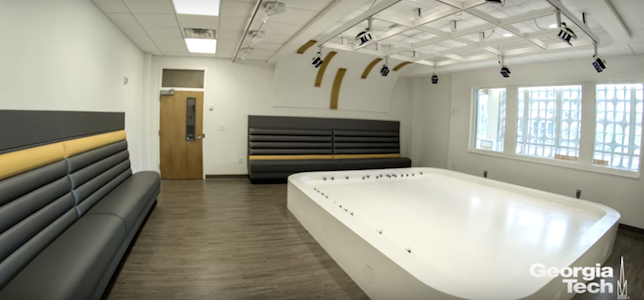
Image Credit: Georgia Tech.
The Georgia Institute of Technology is opening the "Robotarium" this month to allow users from around the world to test out their code on a rotating pair of robot swarms.
The 725-square-foot facility features a 12-inch x 14-inch bowl-shaped court and is home to teams of wheeled and flying swarm robots that users can put their code to the test on after honing it on simulators provided by Georgia Tech. Passersby can see the robots in action through a window and users can watch video captured by motion-activated cameras on the Robotarium's ceiling of the robots running their code.
Magnus Egerstedt, a professor of electrical and computer engineering at Georgia Tech, told Futurity, a university research news organization, that the cost of building and maintaining a world-class lab with multiple robots is steep, which creates a barrier for many budding roboticists looking to enter the field.
"We need to provide more access in order to continue creating the next generation of robots and robot-assisted technologies,” Egerstedt said in the Futurity report. “The Robotarium will allow that at an unprecedented scale.”
Currently, the lab is set up to support 80 rolling 3D-printed robots that come to life when given code and then return to their charging slots once their commands are completed. But every few weeks, the wheeled machines will be swapped out for quadcopters and a net that has been erected just inside the walls for experiments with flying swarms.
Egerstedt and his team worked for a year and a half modifying a miniature version to ready the Robotarium for public use, Futurity reported. The researchers addressed problems like intentionally programmed collisions — solved by creating a virtual barrier around each machine — and other cyber threats. They learned to avoid sending entire swarms of robots shooting toward the ceiling and to make the chargers wireless so that, if the robots ended up fighting for a spot at one of them, they wouldn't short and shower the space with sparks.
More than 100 research groups have used the mini version of the Robotarium to date. The progress is a step toward the Robotarium's mission to "democratize robotics by providing remote access to a state-of-the-art multi-robot research facility," according to its website — a sentiment echoed by Egerstedt in the Futurity report on the facility: "I want to do for robotics what MOOCs have done for education—now anyone who knows how to code can work with robots."
For more information, watch the video below or visit robotarium.gatech.edu.
About the Author
Joshua Bolkan is contributing editor for Campus Technology, THE Journal and STEAM Universe. He can be reached at [email protected].