College Program Promotes 'Freshman Year for Free'
- By Dian Schaffhauser
- 08/24/17
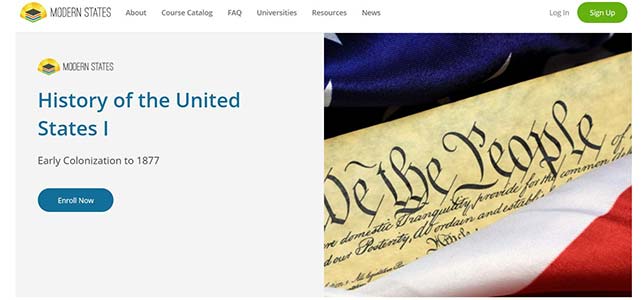
A free "on-ramp" to college has just opened. The Modern States Education Alliance, a philanthropy dedicated to making a college degree more affordable and attainable, has posted a set of on-demand college classes that wannabe-students can take for no cost, including digital textbooks used in the courses. When they feel ready, those same students can take the College-Level Exam Program (CLEP) or Advanced Placement exams issued by the College Board to earn credit for their efforts. Those credits are accepted by 2,900 U.S. institutions, according to the alliance. The program isn't intended just for first-year students, but also for working adults who never finished earning their degrees.
The program gained its name, "Freshman Year for Free," by offering the equivalent number of credits to participants who pass eight exams and apply to attend participating schools. Each participating college decides what scores are needed for credit. The program is led by CEO Steve Klinsky, businessman and philanthropist.
The initiative isn't entirely free. The College Board charges $92 to take each of the AP exams and $85 to take each of the CLEP exams. However, earlier this month Modern States announced it would pay exam fees to the College Board for the first 10,000 test takers. In the future, said Klinsky, the organization hopes "to find donors for exam fees after those 10,000, to keep it free in every sense." However, even if that eventually runs out, those testing fees are far less than the tuition cost of taking a college course. Students with financial need will continue to be able to apply for reduced test fees from the College Board. And military personnel pay nothing for the tests if they go through the U.S. Department of Defense DANTES program, which covers the costs.
The savings to students can be substantial. For example, a person attending the University of Alabama could save nearly $12,000 in in-state tuition and $29,000 in out-of-state tuition by passing tests in biology, calculus, chemistry, computer science, English language and composition, introductory psychology and physics, among other subjects.
The course catalog points to 45 courses, which can be filtered by exam or category (business and management, composition and literature, history and social sciences, science and math, and world languages). Thirty-two of the classes, from American Government to Western Civilization, prepare students for CLEP exams. For those pursuing AP exams, the catalog has 39 units covering 13 separate exams.
The alliance is a non-profit endeavor that hired edX, the massive, open, online platform begun by Harvard and MIT, to complete the development of the college courses. Each course includes online video lectures, quizzes, tests and other features of the classroom. They're taught by professors from leading universities. Textbooks and materials are also provided online, free of charge. Participating systems include New York, Texas, Ohio, Indiana and Tennessee.
[Editor's note: This article has been updated to reflect additional information provided by Modern States.]
About the Author
Dian Schaffhauser is a former senior contributing editor for 1105 Media's education publications THE Journal, Campus Technology and Spaces4Learning.