Student Creates Voice Recognition System Using Amazon Echo to Get Around Campus
- By Dian Schaffhauser
- 12/07/17
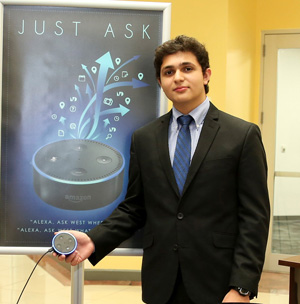
Gutierrez and the Echo Dot
A senior at Miami Dade College's West Campus has programmed the Amazon Echo to help students in need of directions, department hours and other information.
Computer science student Andres Gutierrez tapped into Alexa, Amazon's cloud-based voice recognition service, on an Echo Dot using Node.js, a JavaScript runtime built on Chrome's V8 JavaScript engine. Gutierrez had help from Pedro Santos, manager of the campus's Media and Network Services department, where the student served as an intern earlier this year.
According to coverage in Miami Dade College's newspaper, The Reporter, Santos was interested in creating technology to help students. The two "brainstormed" and came up with the Echo Dot programming project. Now the device sits in the main rotunda on the first floor at West Campus.
To interact with Alexa, a student says, "Alexa, ask West," followed by a question. In a demo profiled in the article, Gutierrez asked Alexa where "testing" was. The response: "Testing is in room 2110, which is down the hall on your right, past the admissions center."
Alexa has been programmed with information about events, specific locations, department hours of operation and other general information about the campus and its administration.
"Being my first experience developing an application for voice, understanding the different user experience was crucial," said Gutierrez. "I'd personally never interacted with Alexa before the project, and my use of Google Assistant had been limited to searches and controlling music. Being able to mess with an Echo and get accustomed to the different input/output pattern turned out to be a great help for developing more natural interactions."
Gutierrez said that aside from working with Node.JS, he had to learn how to use Amazon's Developer Console. "While Amazon has improved the GUI since then to make the process more user-friendly, I still feel this to be the stage with the deepest learning curve, especially since the concepts and workflow in developing for voice 'apps' are like nothing like those I've ever dealt with before while developing for other platforms."
The final thing he said, wasn't technical, but was "highly important nonetheless." That was seeing how a good manager can "kickstart innovation." "I was simply a high school intern. My department head, Pedro Santos, noticed I had a talent, and provided the resources and guidance to realize my potential. Had it not been for his fresh ideas, nurturing support and constant motivation, none of this would've happened."
When Amazon heard about the project, the company sent the student a t-shirt showing a deconstructed Amazon Echo Dot on the front and the phrase "Amazon Alexa // Developer" on the back.
When Gutierrez graduates next spring, he hopes to move on to MIT. But he's already lined up a successor to take over the Alexa work. Andres Mota, a new staff member on the media and networking team, will continue developing and refining Alexa's knowledgebase, while the college eyes an expansion of the service to other sites, as well as to additional campuses.
About the Author
Dian Schaffhauser is a former senior contributing editor for 1105 Media's education publications THE Journal, Campus Technology and Spaces4Learning.