Berkeley College Faculty Test VR for Learning
- By Dian Schaffhauser
- 09/05/18
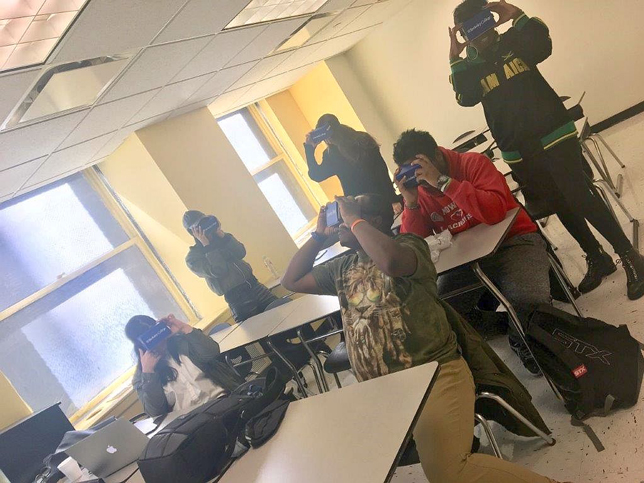
Berkeley College students tap virtual reality to engage with course materials. Source: Berkeley College
In a pilot program at Berkeley College, members of a Virtual Reality Faculty Interest Group tested the use of virtual reality to immerse students in a variety of learning experiences. During winter 2018, seven different instructors in nearly as many disciplines used inexpensive Google Cardboard headsets along with apps on smartphones to virtually place students in North Korea, a taxicab and other environments as part of their classwork.
Participants used free mobile applications such as Within, the New York Times VR, Discovery VR, Jaunt VR and YouTube VR. Their courses included critical writing, international business, business essentials, medical terminology, international banking, public speaking and crisis management.
Most of the students (79 percent) reported feeling more engaged with the course materials when they used the VR apps; a similar number reported that VR enhanced their learning experiences. And all of the participating instructors said they'd use the technology again.
For example, in the "Foundations of Critical Writing" course taught by James Pacello, students were asked to envision themselves as members of a research team charged with exploring emerging technology, specifically VR. They watched pre-selected VR content in class and then wrote short essays using those examples to illustrate their ideas. "Based on my analysis of their essays, their feedback to me during class and ... anonymous survey responses, I found they were engaged in the process, and they were able to articulate why they found the experience compelling," Pacello said in an article about the project. "The examples students used in their written work were very often thoughtful and students seemed to find the content meaningful."
Students in Valbona Gjoligaj's international business class used 360-degree VR to visit North Korea as it held military celebrations for its Worker's Party. According to Gjoligaj, "Students were busier during this individual class compared to a case study or YouTube video class work." And by the end of the class, every student had turned in their VR assignment.
Management instructor Syleecia Thompson used VR technology during a "Career and Business Essentials" course whose learning objectives included examining promotional strategies implemented by entrepreneurs. The VR experience she chose placed students in a taxicab ride that was being pitched by one entrepreneur as a "nightclub on wheels." "The students were engaged from the moment I pulled the glasses out of the box," she noted. "I could tell learning took place based on their conversations with each other, the intense debate about the topic, and the words used such as 'target market' and 'scalability' and 'market segmentation.'"
Based on the results of the project, the working group has developed a repository of VR content as a resource for other instructors; in addition, the college's library has compiled a set of Google Cardboard headsets to make available to faculty on campus.
About the Author
Dian Schaffhauser is a former senior contributing editor for 1105 Media's education publications THE Journal, Campus Technology and Spaces4Learning.