Most Colleges Report Online Students Perform About the Same as Face-to-Face
- By Dian Schaffhauser
- 03/26/19
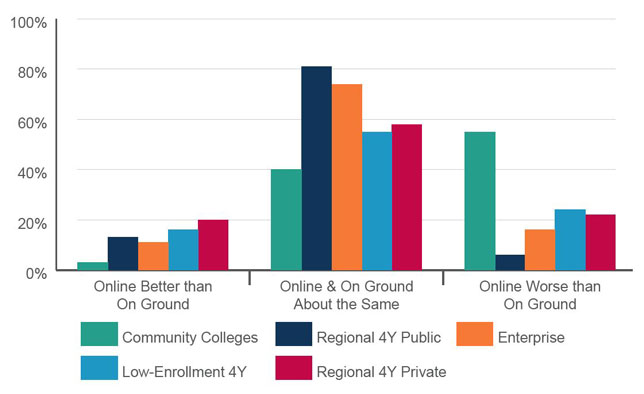
Chief online officers compare performance of students in their fully-online courses versus face-to-face classes (Source: 2019 CHLOE 3 Report)
Students who takes classes fully online perform about the same as their face-to-face counterparts, according to 54 percent of the people in charge of those online programs. Another 11 percent of "chief online officers" (COOs) said the online students did better; and 35 percent said they did worse. Those results came from a recent survey done by Quality Matters and Eduventures Research, the research division of ACT/NRCCUA.
The third annual "Changing Landscape of Online Education" (CHLOE 3) report surveyed 280 COOs (up from 182 last year) at U.S. colleges and universities about policies, practices and plans around online education. Researchers defined the role of "chief online officer" as having lead or shared responsibility for online faculty training, online instructional design and course development, coordination with academic units, online policy development and quality assurance and overall strategic planning.
Community college COOs were the least likely to consider their online students "superior" to the "on-ground" students (just 3 percent said as much); and COOs in regional four-year private schools were the most likely to view their online students as better than the students in their face-to-face programs (a solid 20 percent there).
Eight in 10 institutions have used retention and graduation rates as their benchmark of success to measure the effectiveness of their fully online programs. Nearly six in 10 (59 percent) examined program achievement — with student grades used most often as the proxy for that. From there, it was a "sharp drop-off" in the use other student outcome metrics, especially those with external outcomes, such as graduate earnings or student debt. Researchers suggested that one reason most institutions don't focus on those measures or indicators of their students' success is that they're not being pressured to do so "by regulators, accreditors [or] the general public to provide this kind of accountability."
In regional, public four-year schools a whopping 94 percent of respondents said their fully online students performed as well or better than on-ground peers, while just 43 percent of those in community colleges said the same. The researchers asserted that those "disparate outcomes" could be a result of "differing online student characteristics, online program structure, pedagogy and student support infrastructure."
The full report, which explores trends in the management of online education as well as the tools and techniques employed in online programs, is available on the Quality Matters site (registration required). A webinar on the findings will take place on April 11, 2019 at 1 p.m. Eastern time; the event is open to members and non-members.
About the Author
Dian Schaffhauser is a former senior contributing editor for 1105 Media's education publications THE Journal, Campus Technology and Spaces4Learning.