Optoma Updates Laser Projector Line with New Ultra Short Throw Models
- By Dian Schaffhauser
- 09/16/19
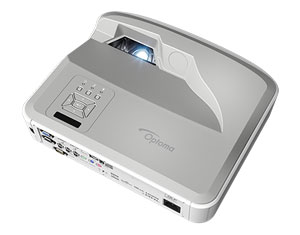
Optoma ZU500UST
Display company Optoma has added new models to its laser and lamp projector series, all designed for education.
In the laser series, two new ultra-short-throw projectors are wireless, have 5,000 lumens of brightness and produce images up to 120-inches in size. The new Optoma ZH500UST, which is priced at $3,199, features 1920x1080 resolution. The ZU500UST, priced at $3,299, has 1920x1200 resolution.
Besides having ports for HDMI and VGA connections, the devices are equipped with USB image viewers and office document readers, to allow users to play audio, images and other files without a PC. They also include digital signage mode support and "four-corner adjustment," which allows for quick image adjustment from any corner of the image in situations where the projection surface is angled or uneven. Connected to the campus network, audiovisual administrators can control the projector via telnet and Crestron in managed installations.
The company estimated the light source life at up to 30,000 hours in "eco-mode."
In Optoma's lamp series, the W412 ($619) features 1280x800 WXGA resolution and 4,400 lumens of brightness. It can support 4K UHD HDR input sources. The X412 model ($519) delivers 1024x768 XGA resolution and 4,200 lumens and handles HDMI and VGA inputs. Both lamp projectors feature flexible zoom, keystone correction and RS-232 control. They also have a lamp life estimated at 15,000 hours and 10-watt speakers.
For more information, visit the Optoma site.
About the Author
Dian Schaffhauser is a former senior contributing editor for 1105 Media's education publications THE Journal, Campus Technology and Spaces4Learning.