Harvard Initiative to Fund Student Ed Tech Ideas
Operation Impact will provide student entrepreneurs with dollars and support to create "impact-focused" startups that focus on issues that educators face around the world.
Harvard University is looking to provide students with resources to develop innovative solutions that address issues educators and learners face around the world. The new initiative, Operation Impact, provides funding, infrastructure and mentorship to student entrepreneurs to create and develop "impact-focused" startups.
Over the past year, Operation Impact has funded several projects from student teams in its beta program. Some of those projects include fighting "pervasive burnout" in new educators, improving and promoting access to STEM education across the country, and creating immersive reality experiences for healthcare students to improve relationships with "stigmatized" patients within the healthcare system.
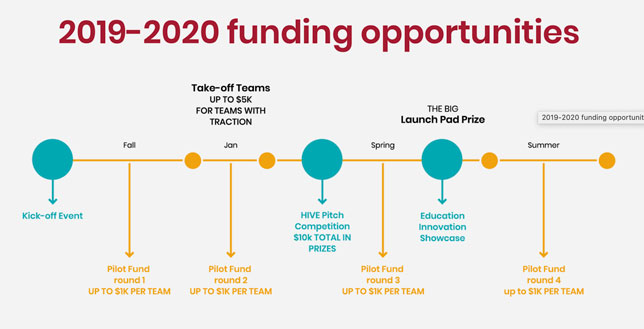
Operation Impact timeline
"Harvard has long been an incubator for creative and entrepreneurial ideas around teaching and learning, and Operation Impact is tapping into those energies and talents in new ways," said Bharat Anand, who leads the Office of the Vice Provost for Advances in Learning, which administers the initiative.
The initiative is open to all Harvard students who are in degree-granting programs. Students from the Massachusetts Institute of Technology were also invited this year to collaborate with Harvard students to create education innovation teams.
For the next three years, Smart Technologies will be supporting eight fellows to serve as "on-the-ground mentors" to help Operation Impact teams apply for funding and connect with external experts. The company is also providing Harvard students with Smart software and hardware to enable collaboration among students and "support the ideation process."
Each team will also utilize Wix's web design and content platform to build professional websites and gain access to Amazon Web Service's cloud-based system to build their innovations through AWS Educate. RallyCry Ventures is providing support for Operation Impact's culminating annual award, called the Launch Pad prize, and helping teams with the design process.
More information on the initiative can be found on Operation Impact's website.
About the Author
 Sara Friedman is a reporter/producer for Campus Technology, THE Journal and STEAM Universe covering education policy and a wide range of other public-sector IT topics.
Friedman is a graduate of Ithaca College, where she studied journalism, politics and international communications.
Friedman can be contacted at [email protected] or follow her on Twitter @SaraEFriedman.
Click here for previous articles by Friedman.