6 Colleges Launch or Expand Esports Programs
- By Dian Schaffhauser
- 09/24/19
Recently, Northcentral Technical College in Wisconsin said it was launching a varsity team that would compete as a member of the National Association of Collegiate Esports (NACE), a governing body for college esports. Northcentral is seeking to put together a roster of between 14 and 28 players who will each initially compete in one of three games: Overwatch, League of Legends and Rocket League.
Soon, according to the college, teams will have access to a new "state-of-the-art" esports arena. The 1,200-square foot space will accommodate 24 high-end computers, chairs and desks, as well as a 98-inch TV for team film review and three additional 55-inch TVs with console gaming stations for Nintendo Switch, PS4 and Xbox One. That facility will be available for use by student groups, K-12 schools and other community organizations when it's not in use by the college players.
To participate, students will need to take at least 12 credits each semester and maintain a grade point average of 2.0.
The State University of New York Canton, another NACE member, will be adding two new teams to its esports lineup for the fall 2019 semester: Rocket League and Tom Clancy's Rainbow Six Siege. The university also participates in the Eastern Collegiate Athletic Conference (ECAC), which has some 50 member schools.
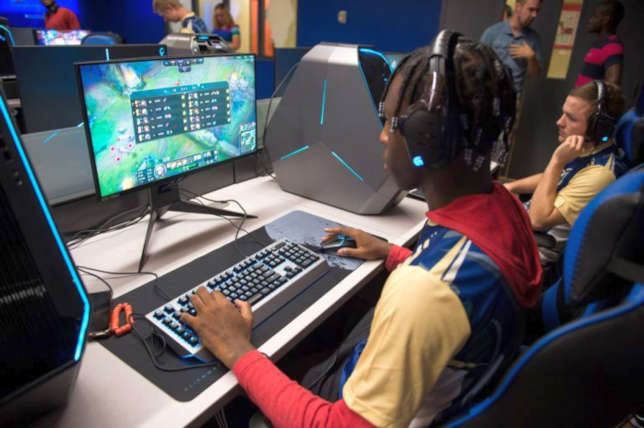
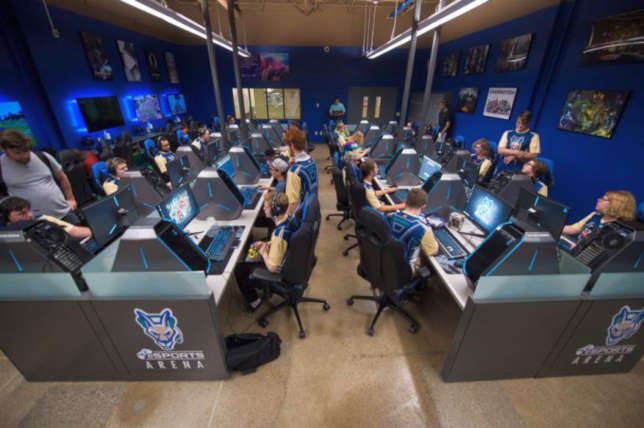
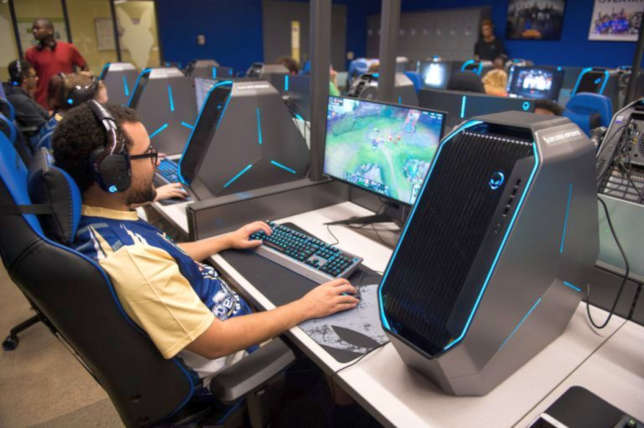
The institution launched its esports program in 2018, when it also built an 1,800-square-foot esports arena outfitted with Alienware Area 51 computing gear for 25 players and a networking infrastructure powered by Extreme Networks. The room includes indirect lighting, lockers for students and a team meeting space that will double as a station for live streaming of games. Funding for the space came from the SUNY Canton Provost's Office to encourage additional expansion of programs related to esports. The university already offers courses in game design and development, cybersecurity, graphic and multimedia design and technological communications.
Nichols College announced it would add esports as the 22nd varsity sport. It's the first one that will be available as a co-ed sport on its Massachusetts campus. Players will compete in two different games -- Rocket League and NBA2K -- "with additions to come as the program evolves," the college noted.
Nichols' Director of Business System Strategies and Web Applications, Charles Tousignant, will serve as the inaugural head coach; Marketing Director, David Leary, will serve as an assistant.
"Nichols students have been expressing an interest in esports and holding their own tournaments for a while," said Tousignant, in a statement. "We realized that it was time for the institution to recognize the value that video games and collegiate competition can bring to their education. Team strategies in video games translate directly to business acumen, and we believe that by encouraging a sense of togetherness and competition, we can positively affect the futures of our players."
On the west coast, Pepperdine University has launched an esports program. According to student reporting, the school launched its esports program over the summer, pulling together a team that participated in a collegiate Overwatch tournament hosted by professional esports team the Los Angeles Valiant.
The esports effort kicked off last spring when an informational meeting drew some 100 students. According to the director of campus recreation, Robb Bolton, "that's by far the most" interest he's seen in "anything we've ever put out there."
The University of Central Missouri's new esports team will grant participants scholarships of $1,000 apiece. The effort will be led by Steven Shattuck, an assistant professor in the School of Computer Science and Mathematics. Shattuck said the university had been working with NACE to set up the esports program. The initial structure will have two teams of six students each with three additional students serving as alternates. Play will take place in the cybersecurity lab.
Michigan Technological University also announced plans to launch a varsity esports program in fall 2020. The program will be affiliated with NACE. The school already has several student gaming organizations and found in a survey that about seven in 10 first-year students identify as gamers. Currently, the institution is seeking a program director and developing plans to convert two racquetball courts into a gaming arena.
About the Author
Dian Schaffhauser is a former senior contributing editor for 1105 Media's education publications THE Journal, Campus Technology and Spaces4Learning.