College Websites, E-mail Among the Most Important Information Sources for Prospective Students
When prospective students are learning about colleges, their top information source is e-mails from the school, according to a report from Eduventures, the research arm of NRCCUA. Based on a national survey of about 1,100 sophomores, juniors and seniors in high school, the Eduventures 2019 Student Sentiment Research Report explores students' college search behaviors and communication preferences across various stages of the college search process.
In that initial awareness stage, college e-mails were rated as the highest impact information source by 62 percent of the students surveyed, followed by word of mouth from family and friends (57 percent) and school websites (46 percent). On the other end of the spectrum, public transportation advertising (2 percent), radio or music streaming ads (4 percent) and billboard advertising (5 percent) were the lowest impact sources for raising college awareness.
Notably, social media received a middling ranking from students — 35 percent of respondents said they use it in their college search — yet only 4 percent said they trust it as an information source.
Once students have identified schools of interest, their top information source changes: Campus tours and open houses received the highest ranking, cited by 63 percent of survey respondents. But college websites (52 percent) and e-mails (41 percent) remain important. All three (in that order) are also the key sources when students are making their final enrollment decisions, albeit in slightly different proportions.
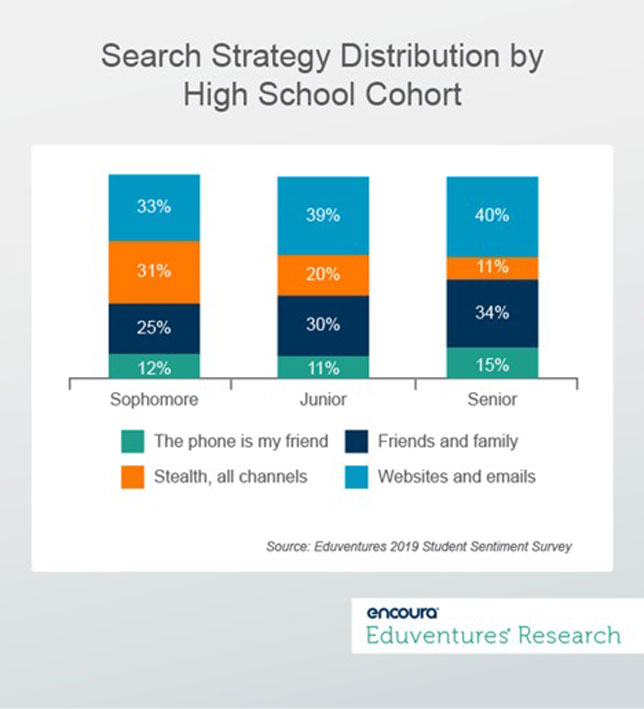
Overall, the report categorized students into four distinct "search strategy" types:
- Websites and E-mails (37 percent of respondents): "Students who use this search strategy primarily trust the information they gather through institutional websites and from institutional e-mails. They also rely more often on search engines than their peers," the report noted.
- Friends and Family (30 percent): "Students who use this search strategy trust word-of-mouth perspectives from family and friends more than any other information source."
- Stealth, All Channels (20 percent): "Students who use this search strategy trust information sources that do not require reciprocation (i.e., e-mails from schools, postcards or brochures or print guides to colleges.)"
- The Phone Is My Friend (13 percent): "Students who use this search strategy seek interactions with institutional stakeholders. These students put a great deal of trust in the information they can glean from faculty, current students and alumni, and administrators at schools they are considering."
Eduventures came up with three recommendations for college recruitment marketers and admissions officers:
- Consider the college website the gateway to recruitment. "This channel remains a key resource of information for many students throughout their entire college search process," the report said, and therefore "needs to be well-designed, visually pleasing, informative, easy to navigate, but it must also be consistent with the institutional identity."
- Manage multiple channels — but one consistent identity. Because students gain awareness, learn about and evaluate schools via many different information sources, "a multi-channel approach to recruitment is best," the report said. Yet maintaining a consistent institutional identity across those channels can be tricky, particularly with subtle factors like tone: "Receiving humorous postcards and e-mails, but experiencing matter-of-fact campus tours, for instance, can be confusing and off-putting to students," the report pointed out.
- Develop a strategy for key influencers. "The admissions office serves as the liaison with not only students but also their communities," the report said, including families, friends, teachers and counselors.
"As the Student Sentiment Research Report results show, it takes hard, long-term work and collaboration between the admissions and marketing teams to move a prospective student from initial awareness about a school to enrollment," said Johanna Trovato, Eduventures senior analyst and primary author of the study. "Each stage in the college search process requires a different outreach strategy that fits within the students' search behaviors at the particular stage."
About the Author
Rhea Kelly is editor in chief for Campus Technology, THE Journal, and Spaces4Learning. She can be reached at [email protected].