Community College Esports Program to Foster Communication and Community
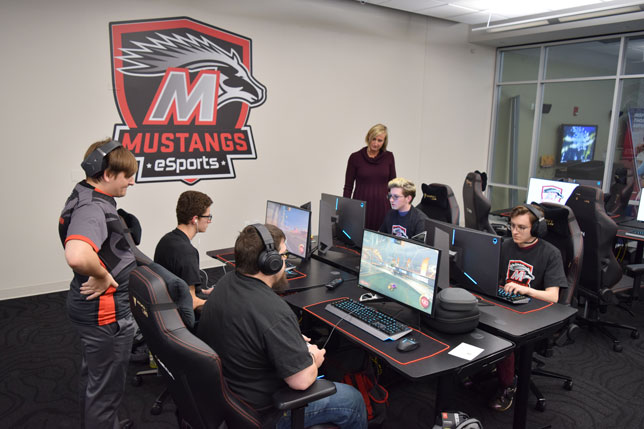
Esports student-athletes at Montgomery County Community College
A new coed esports program at Pennsylvania's Montgomery County Community College will involve more than just playing video games. Starting next spring, Mustangs eSports aims to engage students with a sense of community and inclusivity.
"A major benefit of Mustangs eSports is that it will bring together students who have a shared passion, and it will encourage them to communicate with each other as they work together developing their strategy and resolving conflicts," said Ryan Plummer, esports coordinator and coach, in a statement. "Through practice and competition, they will learn to work well as a team. All of these skills will help them succeed in the classroom and in their careers."
"At MCCC, the 'e' in Mustangs eSports stands for everyone," added Kelly Dunbar, director of athletics and campus recreation. "On our campuses, we foster an all-inclusive environment where everyone feels they belong. ESports provides an opportunity for all students to participate on a varsity team."
To qualify for Mustangs eSports, students must be enrolled in one of the college's academic programs, take a least 12 credits per semester, earn a grade point average of at least 2.0, and pass a physical. In practice rounds, students warm up with stretches, review skills and techniques to improve performance, and exercise to increase endurance and hand-eye coordination.
For the program's first season, students will compete in Rocket League, a soccer video game in which players control rocket-powered cars to hit the ball.
MCCC hopes its esports program will "open the door for other possibilities, including the potential expansion of academic programs, particularly in the technology field, and integrated learning opportunities with community and industry partners," the college said in a news announcement.
About the Author
Rhea Kelly is editor in chief for Campus Technology, THE Journal, and Spaces4Learning. She can be reached at [email protected].