Johns Hopkins Dashboard Maps Global Coronavirus Cases
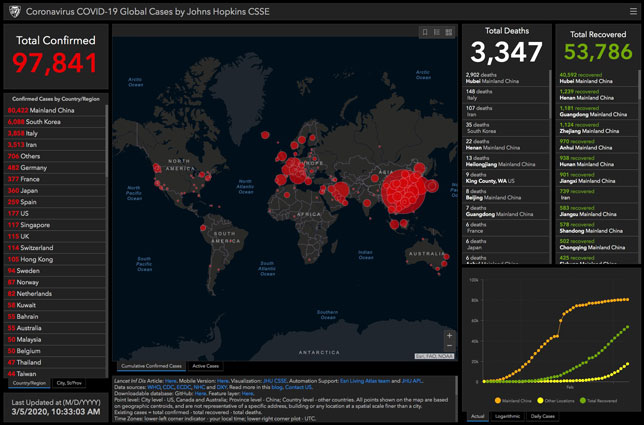
Coronavirus dashboard

Screen capture of the dashboard as of March 5, 2020

The Center for Systems Science and Engineering at Johns Hopkins University has developed an interactive, web-based dashboard that tracks the status of COVID-19 around the world. The resource provides a visualization of the "location and number of confirmed COVID-19 cases, deaths and recoveries for all affected countries," according to a university blog post.

The primary data source for the tool is DXY, a Chinese platform that "aggregates local media and government reports to provide COVID-19 cumulative case totals in near real-time at the province level in China and country level otherwise," the post explained. Additional data comes from Twitter feeds, online news services and direct communication sent through the dashboard. Johns Hopkins then confirms the case numbers with regional and local health departments.

All data from the dashboard is also freely available in a GitHub repository.

About the Author

Rhea Kelly is editor in chief for Campus Technology, THE Journal, and Spaces4Learning. She can be reached at [email protected].

Featured

  • abstract colored blocks

    OpenAI Drops Sora Short-Form AI Video Platform

    OpenAI is reportedly dropping Sora, its generative AI model that creates short video clips from text prompts, images, or existing video inputs. The move upends the company's December partnership with The Walt Disney Company.

  • Businessman holding Chatbot with binary code, message and data 3d rendering

    Anthropic Criticizes OpenAI Ad Strategy

    Anthropic recently launched a multi-million dollar Super Bowl advertising campaign criticizing OpenAI's decision to start showing ads within ChatGPT.

  • Digital Network of User Profiles and Data Connections

    Microsoft, RSA Make Identity Security Push in the Age of AI

    Two of the bigger authentication announcements to come out of the recent RSA Conference both point in the same direction: Organizations need a more flexible, unified approach to identity security, especially as AI agents start acting alongside human workers.

  • workshop participants discuss sustainability in open science and research

    Open Source: Advancing Our Digital Commons

    IT leaders are recognizing the benefits of a return to open strategies. CT asked Jack Suess, VP of IT and CIO at UMBC, for his views on returning to the digital commons of open source.