Google Classroom Tops Education App Downloads

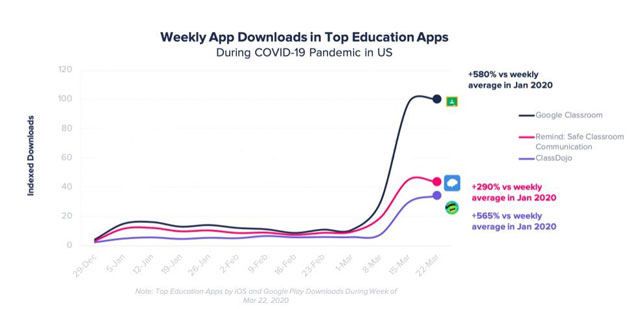
The top education apps downloaded during the week of March 22, 2020, from the Apple App Store and Google Play.

The top education apps downloaded during the week of March 22, 2020, from the Apple App Store and Google Play. Source: App Annie

A new analysis by App Annie has found that mobile education applications have experienced a 90 percent increase in weekly downloads usage worldwide between the last three months of 2019 and the first three months of 2020. For the United States Overall growth rate in education app downloads in the United States alone was 135 percent. But that was beat out by Australia, where the rate of increase was 190 percent; the United Kingdom, where it was 150 percent; and Brazil, where it was 140 percent. App Annie is a company that develops mobile market data.

For the United States, the top three education apps in use during Mar. 22, 2020 were Google Classroom, Remind: Safe Classroom Communication and ClassDojo for sharing photos, videos, announcements and private messages with families. The following week, Google Classroom came in fourth among all non-gaming applications by downloads, beat out by Zoom Cloud Meetings in the number one spot, TikTok in second place and group video app Houseparty in third place.

The company reported that Flipgrid, a short-form educational video platform, has also seen strong growth, rising dramatically from position number 620 just a month ago to spot number 43 most recently.

The data was shared as a "mobile minute" on the company's website.

About the Author

Dian Schaffhauser is a former senior contributing editor for 1105 Media's education publications THE Journal, Campus Technology and Spaces4Learning.

Featured

  • Abstract neural network 3D illustration

    IntelĀ® AI EmpowerED: The AI-Ready Campus, Delivered

    Artificial intelligence is transforming higher education, prompting institutions to rethink how they manage infrastructure, security, governance, and workforce readiness. Successful adoption requires a strategic, institution-wide approach that aligns AI initiatives with educational goals, faculty enablement, and scalable operational frameworks.

  • Robot typing on fluorescent keyboard

    The Wrong Battle: Why Your Institution's AI Policy Is Probably Solving the Wrong Problem

    The conversation on most campuses has become consumed with detection: How do we catch students using AI when they shouldn't? The impulse to protect academic integrity is legitimate, but the detection-first approach has a fatal flaw.

  • Neon blue security locks with a single red highlight

    AI Shifts Cybersecurity Focus from Finding Flaws to Fixing Them

    For decades, one of cybersecurity's most difficult challenges has been finding vulnerabilities before attackers do. A growing number of security professionals now say artificial intelligence is changing that equation, shifting the focus from discovering flaws to fixing them quickly enough to prevent exploitation.

  • humanoid robot with circuit board background

    Meta Expands into Physical AI with Acquisition of Robotics AI Startup

    Meta Platforms has acquired Assured Robot Intelligence (ARI), a robotics artificial intelligence startup focused on humanoid systems, as the company expands its AI work beyond software and into models that could help robots operate in physical environments.