Colleges Show Great Interest in Alternative Credentials But Weak Follow-Through
- By Dian Schaffhauser
- 05/15/20
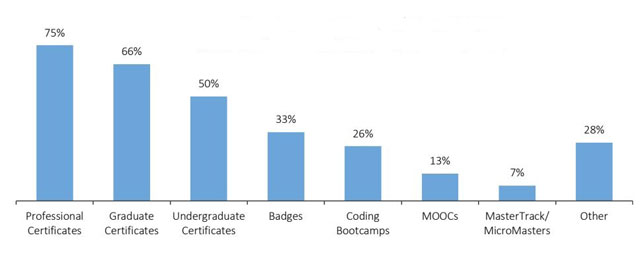
A breakdown of the types of alternative credentials offered by colleges and universities. Source: "The State of the Alternative Credential Market: UPCEA Member Survey Results," from UPCEA and MindEdge.
No matter what type of alternative credential students are earning, most institutions don't retain official information about it. In a recent survey, just a third of institutions (38 percent) that offer alternative credentials said they allow those to be represented on students' university records. Nearly half (48 percent) said they weren't in student records; and another 14 percent said they didn't know. Those responses include institutions that deliver credentials as graduate and undergraduate certificates, which are intended to serve as degree supplements.
The survey, undertaken by the University Professional and Continuing Education Association (UPCEA) and online learning producer MindEdge, found that two-thirds of respondents in colleges and universities (68 percent) have seen growing interest in alternative credentials among students in recent years, and nearly half (46 percent) would call it "significant growth" in interest.
An invitation to take the survey was sent out to 400 member institutions. A total of 177 individuals responded. Among survey participants, 56 percent worked for public institutions, 37 percent for private. The remainder included community colleges, for-profits and "other."
The goal of the survey was to understand the relationship higher ed has with alternative credentials. Right now, it's definitely in the dating stage.
Seven in 10 schools offer alternative credentials; among the remainder, nearly all intend to do so in the future. The most common type was the professional certificate, offered by three-quarters of institutions, followed by graduate (66 percent) and undergraduate (50 percent) certificates. Coding boot camps were available through 26 percent of campuses, and MOOCs had a presence in 13 percent.
The graduate and undergraduate certificates were the most likely form of alternative credential to be credit-bearing among respondent schools, followed by "MasterTrack" and "MicroMasters."
More than nine in 10 (93 percent) agreed to some extent that these credentials engage people with demographics that differ from the students in traditional programs.
Respondents said their "inspiration" for creating alternative credentials came from the staff (29 percent), followed by market need analysis (20 percent) and approval from higher-up school officials (18 percent).
The biggest problems with alternative credentials were that they're undervalued (mentioned by 34 percent of survey participants) and that they lack university support (designated by 30 percent).
By not paying closer attention to the potential for alternative credentials, the UPCEA suggested, colleges and universities are leaving money on the table. "The traditional model for higher education is showing signs of stress, if not obsolescence, a commonplace observation that is underscored by the pandemic," said UPCEA CEO Bob Hansen, in a statement. "Alternative credentials have lower risk and shorter timelines and can stack toward a larger credential such as a degree. In short, credential innovation is a revenue stream not to be ignored moving forward."
The complete report is available with registration on the MindEdge website.
About the Author
Dian Schaffhauser is a former senior contributing editor for 1105 Media's education publications THE Journal, Campus Technology and Spaces4Learning.