Purdue Shares Look Inside HyFlex Classroom
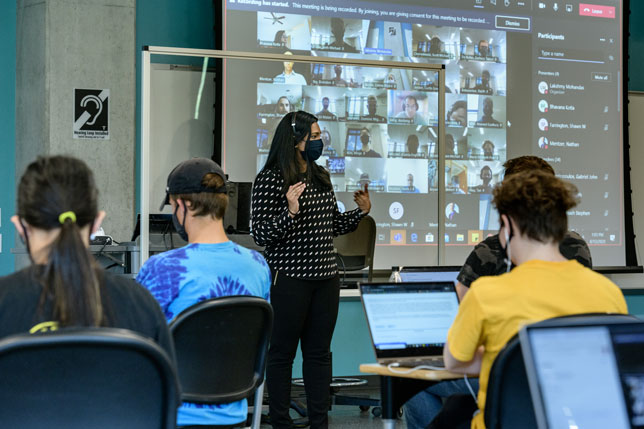
The HyFlex model is giving Purdue students the option to participate in class remotely in real time or physically attend on any given day. Photo: John Underwood/Purdue University
Nathan Mentzer, an associate professor in Purdue University's Polytechnic Institute and College of Education, got an early start with the HyFlex model just as the COVID-19 pandemic was starting to impact higher ed institutions across the country: He started blending both face-to-face and online instruction in his classrooms weeks before Purdue officially shifted to remote learning last spring.
Mentzer wanted his students to be able to participate in class remotely in real time or physically attend on any given day, according to a university news story. "Before spring break, I could see that we were headed in the direction of online learning," he said. "I wanted to help my students make that transition, knowing that the pandemic was likely going to have a long-lasting impact on how we approach teaching."
Together with graduate student Lakshmy Mohandas and Shawn Farrington, a continuing lecturer and course coordinator, Mentzer continued that HyFlex model in the summer. In his Design Thinking in Technology (Tech120) course, for example, Mentzer and his remote students attended online via Microsoft Teams while Mohandas taught face-to-face in the classroom. Online participants were displayed on a large screen at the front of the room.
The flexibility and versatility of the HyFlex model has been a key benefit, said Chantal Levesque-Bristol, director of teaching success at Purdue. "If students are unable to come to class for a period of time because they are in isolation or quarantined, they can complete the requirements online and continue progressing in the course," she noted. "When students are able to come back to the face-to-face class, they have not been delayed in the course progression. This also allows flexibility to the members of the instructional staff (instructors and teacher assistants) who need to teach remotely if needed."
Mentzer plans to continue the approach through the fall semester. In fact, all fall Tech120 face-to-face courses are incorporating the HyFlex model, and interest has spread to other departments.
"Faculty across the university are requesting the support materials we created, including student 'how to videos' and procedures for setting up the blended environment integrating Microsoft Teams for video/audio interaction at the whole- and small-group level (during and after class) and Brightspace (for course content)," said Mentzer. "We invested a significant effort this spring and summer in preparation for the fall, and students tell us it works for them. We are happy to share with others across campus and globally."
About the Author
Rhea Kelly is editor in chief for Campus Technology, THE Journal, and Spaces4Learning. She can be reached at [email protected].