U Tennessee Experiments with VR Course Delivery
Courtesty of University of Tennessee
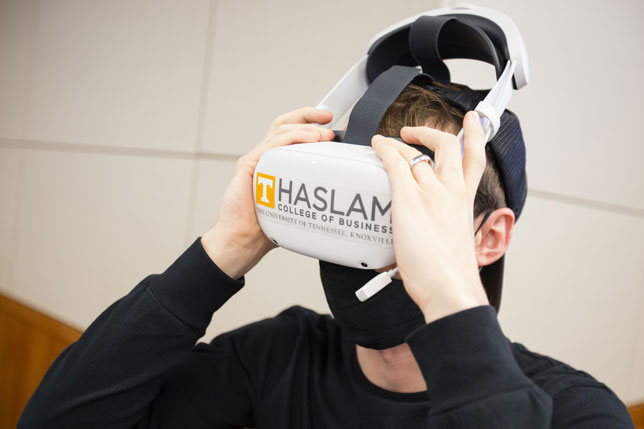
A fall 2021 capstone marketing course at the University of Tennessee, Knoxville's Haslam College of Business used virtual reality as a regular delivery modality. Students in an experimental hybrid section of Marketing Strategy attended both face-to-face and remote VR class sessions, while another section was taught entirely face-to-face.
Students in the hybrid section used Oculus Quest 2 headsets to attend class via the VR platform Spatial. While both sections achieved the same learning outcomes, the VR class "absorbed the material at a higher level," according to instructor Mark Collins, distinguished lecturer of marketing at Haslam and director of the college's Office of Technology-Enhanced Education. "Because it was so different, it made [students] focus and pay attention a lot more," said Collins, in a statement. He added, "The interaction and engagement by the students in VR is night and day compared to if we only had met on Zoom. Part of it, I'm sure, is the fact that they're an avatar, so they don't feel that self-consciousness."
"Having an avatar makes the classroom experience feel personal and like we are all in the room together but also makes it less intimidating," reported marketing student Bridgette Liederbach. "Zoom sometimes makes me uncomfortable to have my camera on and [unmute myself] because I know everyone will see my face pop up on their screen, but using Spatial makes talking in class easier."
Collins plans to use VR for virtual field trips in future sections of his course, and has spoken with other Haslam faculty members about the potential of VR for other courses.
"Across all disciplines, there are moments where we want the students to understand something at a really deep and meaningful level, and we can use VR to make that engagement and interaction happen," he said. "I can see using it in a focused, short time span, to keep it really powerful rather than just becoming the new normal."
About the Author
Rhea Kelly is editor in chief for Campus Technology, THE Journal, and Spaces4Learning. She can be reached at [email protected].