ClassIn Brings Combo CMS, LMS Platform to the U.S.
- By Kristal Kuykendall
- 09/21/22
Virtual and hybrid learning company ClassIn is entering the United States education market this fall, hoping to attract educators' attention with its integrated content management and learning management systems. The platform is used by more than 60,000 K–12 and higher education institutions in 160 countries.
Launched in China in 2017, ClassIn plans to offer several subscriptions and pricing levels, starting with the no-cost base subscription to ClassIn's LMS platform. The ClassInX solution designed specifically for hybrid classrooms includes software and hardware — such as the company's interactive blackboard that connects seamlessly to the LMS and instructional content. Its third solution, called TeacherIn, is described as a marketplace for teaching materials and a co-editor for teachers to create and share their own.
The company touts its "online-merge-offline learning experience," which is summarized in its YouTube videos as connecting online learning to traditionally offline classroom activities. ClassinX, for example, can "seamlessly transform a traditional offline classroom space" through its ability to digitize offline blackboards and instructional content.
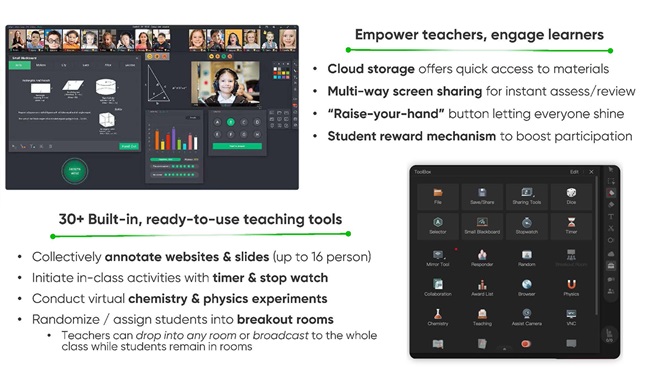
ClassIn uses multi-channel videoconferencing technology with 16 channels of audio and video, and thanks to the company's global cloud communication systems, its synchronization levels average 300ms, the company explained. Their goal of consistent, near-zero latency means a better user experience with less lag and no buffering, said Ted Mo Chen, ClassIn vice president of globalization.
"ClassIn offers more than 20 teaching tools — from drag-and-drop STEM experiment simulation to real-time collaborative annotation for up to 16 students," he said. "And these tools do not only help teachers, they also enable students to become a full participant in class, instead of staring into the void."
Chen touted the platform's emphasis on engaging students with myriad functions fostering interactivity, as well as the synced digital blackboard that allows users to touch the screen to pull in instructional content or host a guest speaker via video call.
ClassIn has established a U.S. subsidiary based in California, with an office in San Francisco, as well as five other offices around the globe. The U.S. solutions launching in Q4 will be hosted on AWS-deployed servers in the United States, the company said.
Its global partners include companies such as Sony Global Education, Pearson, Canvas, Blackboard, The British Council, and Moodle, Chen noted.
About the Author
Kristal Kuykendall is editor, 1105 Media Education Group. She can
be reached at [email protected].