Research: How IT Can Proactively Prepare for Enrollment Cliff, Support Institutional Initiatives
- By Kristal Kuykendall
- 07/13/23
With institutions of higher education experience enrollment declines — and steeper drops projected over the next few years — IT departments must align their efforts with their institutions’ strategies for addressing the downturns, according to a new brief from advisors at Info-Tech Research Group.
The guide, Understand the IT Implications for the Enrollment Cliff, aims to guide IT practitioners in ways they can help their institutions navigate the enrollment cliff impacting higher ed, the firm said.
“The COVID-19 pandemic has also contributed to the enrollment cliff, as it has disrupted many traditional education models and raised concerns about the value of higher education,” says Mark Maby, research director for education at Info-Tech. “This decline poses a significant financial challenge for colleges and universities that rely on tuition revenue. The risk of closure and consolidation is very real.”
In many cases, Maby said, institutional leaders are unaware of the technology implications of their strategic initiatives to address declining enrollment trends, and IT departments may not even be plugged into those initiatives.
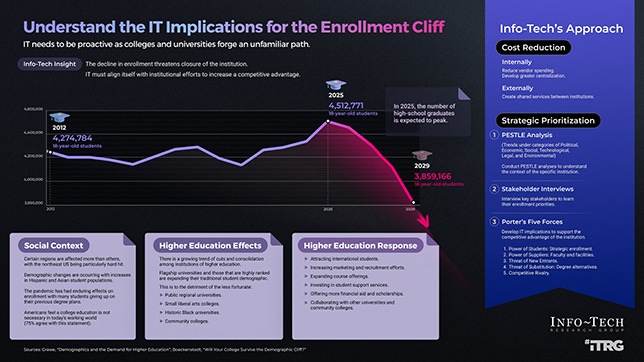
Higher Ed Strategic Responses & Examples of How IT Can Support Them
Some of the most common strategic responses to enrollment declines, and example IT implications, included in the research are:
-
Increasing marketing and recruitment efforts. Example of IT could support this would be implementing a CRM to maximize recruitment efforts.
-
Expanding course offerings to attract more non-traditional students and students seeking micro- and stackable credentials. Example IT support might include implementing a more flexible student information system to meet the changing needs.
-
Investing in student support services. Example IT support for this initiative would be implementing a student success platform to support advising, mental health services, career connections, and more.
-
Offering more financial aid and scholarships. Example IT support would be a student portal that integrates with the financial aid system.
IT Should Also Take Proactive Steps
However, Info-Tech said, IT practitioners can take a number of steps to not only support their campus’ enrollment initiatives but also to prepare for the impacts of steep enrollment declines should they occur.
Info-Tech advises IT departments to take a proactive approach that includes “developing a comprehensive plan that focuses on cost reduction through internal centralization efforts and external partnerships with other institutions,” the research brief advises.
“Additionally, it is crucial to assess the external context of the institution, conduct interviews with key stakeholders to understand their priorities, and determine how IT can support and enhance the institution's competitive advantage,” Maby said.
Given the decline in enrollment and potential for institutional mergers or closures, Info-Tech recommended that IT departments should focus on the following factors:
-
Cost Reduction
-
Internally: Reduce vendor spending through strategic vendor management and cost optimization; develop greater centralization by reducing duplication between central IT and distributed IT.
-
Externally: Create shared services between institutions.
-
Strategic Prioritization
-
PESTLE Analysis: Conduct a PESTLE analysis to understand the effects of external factors on a specific institution: political, economic, social, technological, legal, and environmental.
-
Stakeholder Interviews: Use the PESTLE outcomes to discover the primary objectives of your institution’s stakeholders with respect to their enrollment priorities and adjacent IT prioirites.
-
Porter's Five Forces: Determine the competitive forces facing your specific institution and higher ed at large in order to align IT initiatives to better support the institution's competitive strategy.
-
Power of Students: Strategic Enrollment
-
Power of Suppliers: Faculty and Facilities
-
Threat of New Entrants
-
Threat of Substitution: Degree Alternatives
-
Competitive Rivalry
Download the Understand the IT Implications for the Enrollment Cliff report or learn more at InfoTech.com.