Abilene Christian University Opens Science and Research Center to House Nuclear Research Reactor
- By Kate Lucariello
- 09/27/23
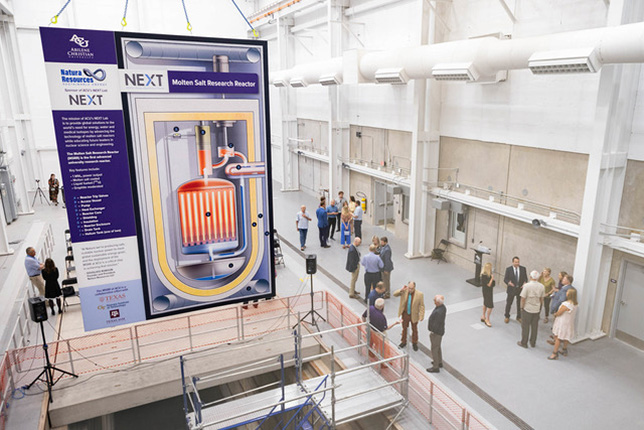
The research bay and an illustrated rendering of the molten salt research reactor in ACU's Dillard Science and Engineering Research Center (Photo courtesy of Abilene Christian University)
Abilene Christian University (ACU) celebrated the grand opening on Sept. 1, 2023, of its Dillard Science and Engineering Research Center (SERC), which will house a research molten salt nuclear reactor, currently being designed. The facility will allow graduate and undergraduate students to contribute to "world-class research and groundbreaking technology," the university said.
The 28,000-square-foot facility will cost $23 million, and includes a 6,000-square-foot research bay, a 25-foot-deep by 80-foot-long shielded trench, and a 40-ton crane, said the university. It will also house a training control room, conference room, office spaces, machine shop, and a series of specialized labs for radiochemistry, molten salt systems, and instrumentation. The foyer will provide information on the research to public visitors.
The facility is made possible by ACU alumna Gayle Dillard and her husband, Max, who founded drilling company D.I. Industries.
The molten salt reactor is being designed jointly by ACU's Nuclear Energy eXperimental Testing (NEXT) Lab and Abilene-based company Natura Resources. Financial support of $30.5 million comes from the Natura Resources Research Alliance, which includes Georgia Institute of Technology, Texas A&M University, and The University of Texas at Austin. The Nuclear Regulatory Commission is currently reviewing the construction permit application.
The university, whose NEXT LaB currently employs 45 undergraduate students, is excited to offer students a part in molten salt reactor research, it said.
"The Dillard Science and Engineering Research Center is a building unlike any other at ACU or on the campus of most universities across the nation," said Phil Schubert, ACU president at the facility's opening. "This 28,000-square-foot facility will allow students, especially undergraduates, to contribute to world-class research and groundbreaking technology in ways not available at most other universities. It also will bring scientists from other organizations and universities to Abilene to collaborate with our scientists and students in this unique space."
David Holcomb, molten salt reactor technology leader at Idaho National Laboratory, also praised the university for "pushing what has been a paper reactor class for more than 50 years back into reality."
"ACU has picked up the gauntlet in the creation of this science and engineering research center. Members of the Natura Resources Research Alliance have the responsibility and privilege of training the next generation of leaders, who I am confident will bring the great potential of this reactor class to fruition," he said.
Visit the Natura Resources About page to learn more about molten salt reactors.
A video about the SERC is available on YouTube.
About the Author
Kate Lucariello is a former newspaper editor, EAST Lab high school teacher and college English teacher.