Google Launches More AI Tools, Open Source AI Agent Platform
Google recently unleashed a slough of generative AI technologies, from the next generation of its open foundation model to an open source AI agent platform.
Late last month, the company announced Gemma 2, the latest version of its flagship open large language model (LLM). Gemma is family of lightweight, state-of-the-art open models built from the same research and technology used to create Google's closed-source AI model, Gemini.
The first Gemma models were released earlier this year. Gemma 2 builds on its predecessor, offering more power at lower cost.
"Available in both 9 billion (9B) and 27 billion (27B) parameter sizes, Gemma 2 is higher-performing and more efficient at inference than the first generation, with significant safety advancements built in," said Google. "In fact, at 27B, it offers competitive alternatives to models more than twice its size, delivering the kind of performance that was only possible with proprietary models as recently as December. And that's now achievable on a single NVIDIA H100 Tensor Core GPU or TPU host, significantly reducing deployment costs."
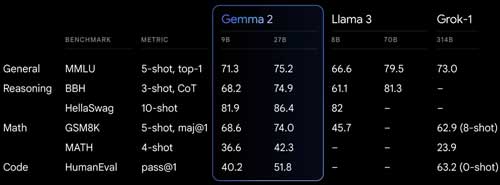 [Click on image for larger view.] Gemma 2 (source: Google).
Project Oscar
Google also recently open sourced a platform for AI agents to take care of project maintenance.
Project Oscar (standing for open source contributor agent architecture) was open sourced by the cloud giant at its I/O Connect event in Bengaluru, India.
It seeks to help point autonomous agents — one of the hottest areas of AI right now — at open source project maintenance. As Google described it in a blog post last week, Project Oscar is "a reference for an AI Agent that helps with open source project maintenance, starting with Go, a project with over 93,000 commits and 2,000 contributors, but you can imagine supporting all kinds of different projects."
Rather than generating, fixing, or explaining code for users in the development process like Copilot and other AI dev assistants, the tool focuses on the more mundane aspects of project maintenance, such as triaging issues, reviewing pull requests, and responding to comments, so developers can focus on the more creative aspects of their projects.
Its goals include:
- Reduce maintainer effort to resolve issues [note that resolve does not always mean fix]
- Reduce maintainer effort to resolve change lists (CLs) or pull requests (PRs) [note that resolve does not always mean submit/merge]
- Reduce maintainer effort to resolve forum questions
- Enable more people to become productive maintainers
Project IDX
This web-based workspace for full-stack app development was unveiled last year.
In a May update, the company said: "As of today, anyone can sign in with their Google account to start building with AI-assistance, collaboration capabilities, support for a broad range of frameworks and languages, as well as seamless integration with popular Google tools and products like Flutter and Firebase. And you can get to work quickly with over a dozen templates pre-loaded with the basic files and packages you need, or by importing your existing GitHub repo and its dependencies, or even starting with a blank slate."
At Bengaluru, the company announced new features for Project IDX, including a waitlist for running Android Studio on IDX.
"Hundreds of thousands of developers are using Project IDX, our web-based workspace for full stack development to build a wide range of apps," the company said today. "Project IDX is now in public beta and we've launched new templates for backends, databases, and solutions -- end-to-end example apps that demonstrate best practices for building apps using our suite of products. You can also integrate with Google Cloud Secret Manager to help protect the secrets that your app needs. And for Android developers, check out an early preview of Android Studio on Project IDX that runs fully in your browser. With just a few clicks, you will be able to set up a workspace that's running Android Studio to quickly start coding, building, and testing native Android apps. Sign up for the waitlist."
And More
Google also announced:
- An early look at AI-generated UI for Flutter, the company's platform that helps devs build, test, and deploy mobile, web, desktop and embedded experiences from a single codebase.
- The new Checks AI Safety service, now in private preview to help users evaluate, monitor, and oversee the compliance of AI models and agents. "You can run configurable content safety policies, adversarial prompt testing, and in-production app monitoring."
- A new set of Firebase services, including App Hosting, Data Connect with Cloud SQL, and Genkit, the company's new open source AI integration framework. "In addition to TypeScript support, Genkit for Go is now available in alpha to simplify the development of efficient and scalable AI-enabled services and apps, written in Go. We're also unveiling an early look at the Firebase AI Monitoring dashboard, which shows real-time insights into the performance and behavior of features built with LLMs — in production. It is now available in private preview and works seamlessly with Genkit, so sign up for the waitlist.
Google has been on an AI tear recently, with all of the above coming just a couple days after the company announced its new Google Vids AI video generator.
"Vids is an AI-powered video creation app that's designed for work and deeply integrated with the Workspace suite you use every day," Google said in a July 15 e-mail to members of Workspace Labs, an invite-only program where users can experiment with new AI-powered features in wares ranging from Google Docs to Gmail.
Users can join the company's early access group as part of the Google Developer Program to explore the company's latest/greatest new tech.