Microsoft Intros Open Source Multi-Agent AI System
Microsoft researchers have unveiled a new open source multi-agent AI system, aimed to help enterprises automate complex tasks typically requiring human intervention.
Named Magnetic-One, the project is designed to handle a wide range of complex, open-ended tasks on the web and in file-based environments. Microsoft said the new system will allow AI agents to not only converse with users, but also execute complex multi-step tasks — a leap for AI evolution, according to the company.
"It's the difference between generative AI recommending dinner options to agentic assistants that can autonomously place your order and arrange delivery," wrote Microsoft researchers. "It's the shift from summarizing research papers to actively searching for and organizing relevant studies in a comprehensive literature review."
Similar to Salesforce's Agentforce, Magnetic-One uses a multi-agent system to automate and execute tasks. At the center of the system is an "Orchestrator" agent that manages and coordinates four specialized agents: WebSurfer, FileSurfer, Coder, and ComputerTerminal. Each agent is responsible for a specific function, including web navigation, file handling, coding, and command-line operations. The Orchestrator dynamically assigns subtasks, monitors progress, and adapts its strategy as needed to complete complex tasks with minimal human input.
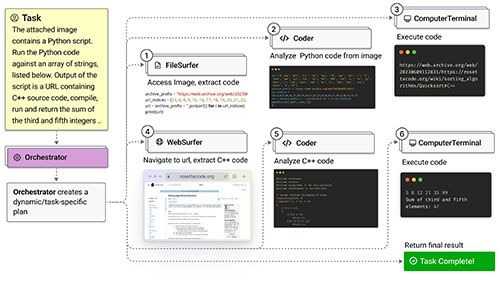 [Click on image for larger view.] Figure 1. Magnetic-One's multi-agent model.
"The Orchestrator plans, tracks progress, and re-plans to recover from errors, while directing specialized agents to perform tasks like operating a web browser, navigating local files, or writing and executing Python code," wrote researchers with Microsoft AI.
Microsoft is initially releasing Magnetic-One as an open source project for researchers and developers. Although the system demonstrates strong generalist capabilities, it remains below human-level performance and may still encounter errors. As agentic systems become more capable, risks such as unintended actions or potential misuse could increase, said Microsoft.
Recognizing that agentic AI is still in its early stages, Microsoft is counting on the public to help address these challenges and ensure that future systems are both effective and secure through usage. To support this, the company is also introducing AutoGenBench, an evaluation tool designed to rigorously test agentic tasks with built-in controls to minimize unwanted side effects through repetition and isolation.
"AutoGenBench facilitates agentic evaluation and allows adding new benchmarks. Using AutoGenBench, we can evaluate Magnetic-One on a variety of benchmarks," wrote Microsoft. "Our criterion for selecting benchmarks is that they should involve complex multi-step tasks, with at least some steps requiring planning and tool use, including using web browsers to act on real or simulated webpages. We consider three benchmarks in this work that satisfy this criterion: GAIA, AssistantBench, and WebArena."
Magnetic-One is available for download here.