Google Reimagines Search with AI Mode
About a year after launching AI Overviews in its flagship search offering, Google has announced broad availability of AI Mode in Search.
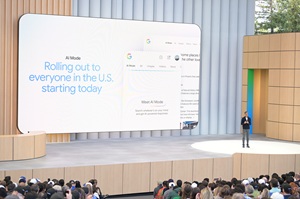 [Click on image for larger view.] CEO Sundar Pichai Introduces the Rollout of AI Mode (source: Google).
"As we've rolled out AI Overviews, we've heard from power users who want an end-to-end AI Search experience," Google said at the start of the I/O developer's conference. "So earlier this year we began testing AI Mode in Search in Labs, and starting today we're rolling out AI Mode in the U.S. — no Labs sign-up required. AI Mode is our most powerful AI search, with more advanced reasoning and multimodality, and the ability to go deeper through follow-up questions and helpful links to the web. Over the coming weeks, you'll see a new tab for AI Mode appear in Search and in the search bar in the Google app."
While AI Overviews provided concise, synthesized summaries of information in response to search queries, using generative AI to pull together relevant facts from across the web, AI Mode in Search enables users to pose complex, multi-part questions naturally, offering detailed summaries rather than traditional lists of links.
Key features include:
- Conversational Interface: Supports dynamic back-and-forth interactions, facilitating easy follow-up questions.
- Multimodal Input: Accepts queries via text, voice, or images, increasing search flexibility.
- Comprehensive Responses: Generates detailed, synthesized answers powered by Google's Gemini models.
- Personalized Results: Provides context-aware and personalized search experiences.
- Seamless Integration: Integrates information from Google's Knowledge Graph and other services for richer results.
What's more, AI Mode in Search is also being put to use in the company's new Deep Search initiative, which is designed to handle complex, multi-faceted queries. Deep Search uses the same query fan-out technique (automatically generating and issuing multiple related sub-queries) as AI Mode but taken to the next level. It can issue hundreds of searches, reason across disparate pieces of information, and create an expert-level fully-cited report in just minutes, saving you hours of research. Highlights include:
- Issuing Multiple Queries: Automatically generates and processes related searches to provide comprehensive information.
- Advanced Reasoning: Uses the Gemini 2.5 AI model to synthesize detailed, nuanced answers from multiple sources.
- Expert-Level Reports: Produces in-depth reports, complete with citations, for thorough exploration of complex topics.
This functionality extends the capabilities of Google's AI Mode, moving beyond simple query responses to more elaborate, research-oriented outputs.
Other search-related features announced by Google at I/O include:
- Live Capabilities: Using Project Astra's tech, AI Mode can respond in real time to what your camera sees — offering explanations, suggestions, and helpful links through a "Live" icon in Lens or AI Mode.
- Agentic Capabilities for Task Automation: AI Mode can perform multi-step tasks like finding tickets or making reservations by fanning out queries, analyzing options, and assisting with form completion — all while keeping the user in control.
- Enhanced AI Shopping Experience: Combines Gemini's reasoning with the Shopping Graph to offer product recommendations, virtual try-ons via uploaded images, and agentic checkout using Google Pay when price conditions are met.
- Personal Context Integration: With opt-in access to data from services like Gmail, AI Mode can tailor results based on previous searches, bookings, and travel plans — offering hyper-relevant suggestions like restaurants and events near your hotel.
- Custom Charts and Graphs: AI Mode can generate interactive, query-specific data visualizations — such as comparing sports team performance or analyzing financial trends — based on real-time data.
About the Author
David Ramel is an editor and writer at Converge 360.