Report: Falling Behind in AI Adoption Comes at Substantial Cost
A recent report from Couchbase has cautioned that enterprises that do not keep pace in AI adoption face potential financial losses. The "Couchbase FY 2026 CIO AI Survey" calculated an average annual impact of up to $87 million for organizations that fall behind. The study, conducted by Coleman Parkes in April 2025, polled 800 global IT decision-makers across financial services, retail, manufacturing, telecommunications, healthcare, energy and utilities, gaming, and travel and hospitality, to examine trends in AI adoption, investment strategies, and challenges.
Survey Highlights
Key findings of the report as presented in a news release include:
- Falling behind the AI wave has significant consequences: 99% of enterprises have encountered issues that disrupted AI projects or prevented them outright, including problems accessing or managing the required data; perception that the risk of failure had become too high; and an inability to stay on budget. These issues had real consequences, eating up 17% of AI investment and setting strategic goals back by six months on average.
- Closing the data understanding gap is key to control: 70% of enterprises admit their understanding of the data (e.g., the quality and real-time accessibility of data) needed to power AI is "incomplete," contributing to 62% not fully understanding where they are at risk from AI (e.g., through security or data management issues). Conversely, those with greater understanding are more confident, and are 33% more likely to be prepared for agentic AI.
- Data architecture is evolving and requires consolidation: The right data architecture is crucial for AI. Yet enterprises say their current architecture has an average lifespan of 18 months before it can no longer support in-house AI applications. 75% of enterprises have a multi-database architecture, which makes it more difficult to ensure accurate, consistent AI output; 61% do not have the tools to prevent proprietary data from being shared externally, which increases security and compliance risks; and 84% lack the ability to store, manage and index high-dimensional vector data needed for efficient AI use. To address these challenges, all surveyed enterprises are consolidating and simplifying their AI technology stacks to make controlling AI easier and more efficient.
- Encouraging experimentation contributes to AI success: Corporate attitudes about AI have a notable impact on its success. Enterprises that encourage AI experimentation have 10% more AI projects enter production and incur 13% less wasted AI spend than enterprises with a more restrictive approach.
- New developments in AI are rapidly reaching parity: The proportion of AI spend on agentic AI (30% of total), generative AI (35%) and other forms of AI (35%) is almost even, despite agentic AI and gen AI being much newer concepts. This suggests enterprises are investing heavily in keeping up with AI development as 66% worry that AI and different approaches to AI are evolving faster than their organizations can keep pace.
- Inability to keep up with AI increases risk of being replaced: Enterprises recognize AI's potential for disruption, allowing smaller organizations with a better grasp of the technology to replace larger, less agile competitors. More than half (59%) of IT leaders are concerned that their organizations risk being replaced by smaller competitors, yet at the same time 79% believe they can do the same and displace their larger competition.
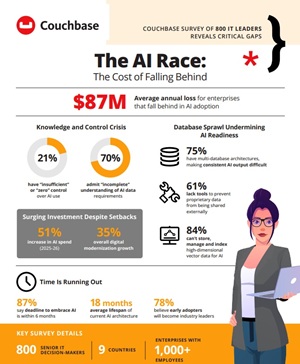 [Click on image for larger view.] Highlights (source: Couchbase).
"The evolution from gen AI to agentic AI is creating vast opportunities for enterprises that can harness these technologies effectively," said CIO Julie Irish. "Creating and operating innovative AI applications at scale is essential for successful enterprises. The right data strategy, including methods to ensure high data quality, scalability and accessibility, is more important than ever to ensure companies unlock the value of AI."
Data Management and Experimentation
The survey indicated that corporate attitudes about AI influence its success. Enterprises that encourage AI experimentation demonstrate more projects reaching production and less wasted AI spend compared to organizations with more restrictive approaches.
AI budget allocations show near parity across generative AI, agentic AI, and other forms of AI, such as machine learning, with each attracting approximately one-third of total AI spend. This suggests significant investment in keeping pace with new AI developments.
Challenges and Consolidation
To address the challenges encountered with AI projects, all surveyed enterprises are consolidating and simplifying their AI technology stacks. This move is supported by a majority of CIOs, who view the current shift to AI as an opportunity to simplify technology stacks broadly.
Outlook
Despite the challenges, IT leaders recognize both the opportunities and the path forward for AI adoption, the survey indicated. The report concluded that "effectively creating and operating innovative AI applications at scale will be a defining characteristic of successful enterprises." This requires a data management strategy, with organizations needing to "implement strong controls and simplify architectures using unified, multipurpose data platforms that can handle diverse data types." Most respondents agree that not embracing AI at all presents a greater risk than the challenges of its implementation.
The full report is available on the Couchbase site.