Gartner Forecasts Increased Spending on Desktop as a Service as Cost Optimization, Sustainability Drive Adoption
While secure remote access remains a key driver of DaaS adoption, a growing number of deployments now focus on broader efficiency goals, according to Gartner's 2025 Magic Quadrant for Desktop as a Service .
DaaS has become a foundational technology across enterprises, not just for supporting remote workers, but as a strategic tool for managing costs, streamlining IT operations and advancing sustainability initiatives. According to Gartner, by 2027, virtual desktops will be financially viable for 95% of the workforce, up dramatically from just 40% in 2019. Moreover, one in five employees is expected to rely on virtual desktops as their main computing environment, double the 2019 figure. These shifts signal that DaaS is transitioning from niche to mainstream within enterprise IT.
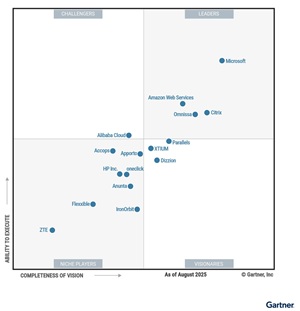 [Click on image for larger view.] 2025 Magic Quadrant for Desktop as a Service (source: Gartner).
DaaS is the provision of virtual desktops by public cloud or other service providers, delivering desktop or application end-user experiences from virtual machines accessed using a remote display protocol. Offerings include a fully managed control plane that brokers user connections and provides a management interface, available either preconfigured as a service or as a platform customers assemble and manage themselves.
Gartner forecasts DaaS spending to grow from $4.3 billion in 2025 to $6.0 billion by 2029, a 7.9% compound annual growth rate. Net-new desktop virtualization deployments are almost exclusively DaaS, with on-premises VDI either migrating to DaaS or adopting a cloud control plane for all but a few specialized cases.
Cost optimization is becoming a driver for adoption. The report notes that total cost of ownership for DaaS, especially when paired with thin-client endpoints, is now lower than that of a laptop PC for many use cases. Vendors are adding AI-based capabilities for right-sizing configurations and improving efficiency.
The 2025 Leaders quadrant features:
- Microsoft – Offers Azure Virtual Desktop, Windows 365 and Microsoft Dev Box, combining self-assembled and vendor-assembled options. Benefits from broad workplace, cloud and AI integration, though Azure Virtual Desktop is seen as more complex to configure than Windows 365.
- AWS – Provides Amazon WorkSpaces and AppStream, with strong geographic coverage, out-of-the-box monitoring and automation, and vertical-specific solutions.
- Citrix – Longstanding desktop virtualization vendor with broad configuration flexibility, regulatory compliance options, and a strategy to deliver an experience "as good or better than a local PC."
- Omnissa – Horizon platform supports on-premises, hybrid and multicloud deployments, with a proprietary protocol optimized for high-latency connections and broad geographic support.
About the Author
David Ramel is an editor and writer at Converge 360.