Rubrik Agent Cloud Expands Policy Controls for Agent Prompts/Responses
Rubrik has announced the general availability of Rubrik Agent Cloud, describing it as a layer between enterprise applications, AI agents, and the underlying large language models, aimed at bringing monitoring, governance, and remediation controls to agent operations.
Governance Focus on Inputs and Outputs
A Rubrik spokesperson emphasized expanded governance in the GA offering, describing policy enforcement that applies to both what goes into agents (prompts) and what comes out of them (responses and tool calls). The spokesperson highlighted two paths: predefined policies that can be applied immediately and custom policies that organizations can define in natural language, with Rubrik small language models helping enforce those policies dynamically on agent interactions.
"Governance needs to move from paper to practice," the company said. "Rubrik Agent Cloud gives you the tools to enforce policies on both the inputs (prompts) and outputs (responses and tool calls) of your agents.
- Predefined Policies: Start immediately with out-of-the-box guardrails, such as PII detection."
- Custom Policies: Define your own unique policies using natural language. Our small language models will help enforce these dynamically on agent interactions."
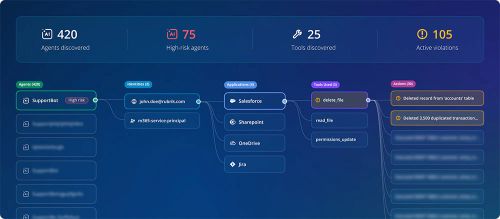 [Click on image for larger view.] Dynamic Governance (from February 2026) (source: Rubrik).
What Rubrik Initially Launched Under Waitlist
The company introduced Rubrik Agent Cloud in October with limited early access, positioning it as an enterprise offering to help organizations adopt AI agents at scale with controls for observability, governance, and remediation. The debut highlighted three core functions: discovering and mapping agents while maintaining audit trails, applying policy enforcement to keep agents within approved boundaries, and rolling back unwanted or destructive agent actions.
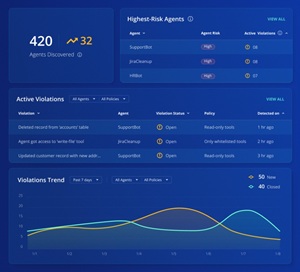 [Click on image for larger view.] Risks and Violations (from October 2025) (source: Rubrik).
Rubrik's original October announcement described the initial feature set in three categories: Agent Monitor, Agent Govern, and Agent Remediate. In that launch description, Rubrik said Agent Monitor would auto-discover and map agents across multiple builders and platforms and maintain immutable audit trails; Agent Govern would define and enforce behavior, access, and action policies in real time; and Agent Remediate would extend Agent Rewind for rollback of agent-driven changes.
What Rubrik Is Stressing in the GA Release
In the GA release, Rubrik frames the governance problem as moving beyond process-only controls and into enforcement that can operate in real time, alongside monitoring and remediation. The GA announcement describes three pillars: continuous monitoring and observability, governance, and remediation, including a rollback-oriented capability tied to Rubrik Agent Rewind.
On monitoring and observability, Rubrik says the platform scans an environment to build an agent inventory and provide discovery, risk profiling, and visibility into what tools and data agents are accessing. On remediation, Rubrik ties Rubrik Agent Rewind to recovery workflows intended to help organizations correlate an agent action with a prior healthy snapshot to recover from mistakes.
For more information, visit the Rubrik blog post.
About the Author
David Ramel is an editor and writer at Converge 360.