Internet2: Closing the Access Gap for Research Cyberinfrastructure
A Q&A with Dana Brunson
Internet2 has supported collaborative research since its founding in 1996 – first through its national network, then by its work in federated identity and access management with InCommon, and more recently via its cloud solutions. And when Dana Brunson joined Internet2 as executive director for research engagement in 2019, she built a strong team to lead research enablement in the Internet2 community. Here, we ask Brunson for her perspectives on the changing research computing and data requirements in higher education, and how Internet2's Research Engagement Team is helping the community close the access gap for institutions of all types and sizes.
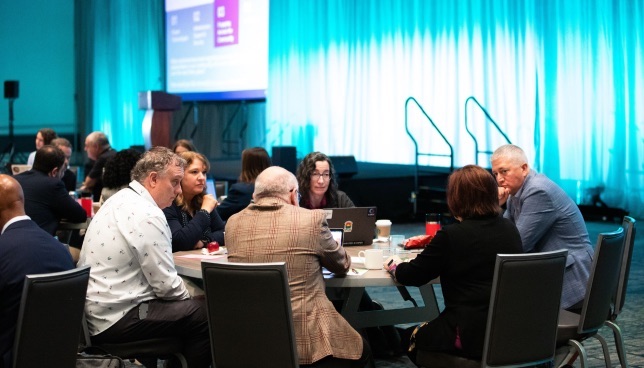 Dana Brunson (center) facilitates a roundtable discussion with research and higher education IT leaders at an Internet2 annual event, where the community convenes to solve shared challenges. (Photo courtesy Internet2)
Mary Grush: What is the mission of Internet2's Research Engagement Team? What are the biggest changes you've seen during your years of leading the team?
Dana Brunson: Our mission is to ensure that researchers and educators — regardless of their discipline or type of institution — have access to the research computing and data tools, services, and resources they need. And that includes whatever might be already on campus, or what is available regionally and nationally as either federally funded or private-sector resources.
The Internet2 Research Engagement Team provides consulting and training for campuses to learn about research cyberinfrastructure and develop strategic plans, and we offer support to bring institutions all the way to realizing execution of those plans.
We also facilitate a professional community for research cyberinfrastructure through CaRCC, the Campus Research Computing Consortium, to develop shared tools and best practices — as well as drawing on other community connections to bring people together. And we advocate for research computing and data (RCD) professionals, to be seen as both research partners and as part of what makes a university a competitive entity, no matter how trying the budget times are.
Our central focus is closing the gap between the well-resourced R1 institutions and those that have faced greater limitations in accessing research cyberinfrastructure: the teaching-focused undergraduate institutions, minority-serving institutions, and every type of campus in between.
As for what's different now, I'd cite two significant trends:
First, it's not just researchers using advanced technology today. Educators in the classroom need access, too, as teaching essential research skills to students becomes an imperative. So, we see that all of this work applies to teaching-focused institutions as well as R1s.
Educators in the classroom need access, too, as teaching essential research skills to students becomes an imperative.
And the second trend I'd point to is a better awareness of the professionals who work on campuses alongside the CIO and support researchers and educators using research technology. These are the RCD professionals — and it's really a new profession over the past decade. Some campuses may not have a person dedicated to research computing facilitation. Other campuses have whole teams who are able to spend time thinking about what their researchers and educators need, and understand what's available in the broader RCD ecosystem.
And that's one of the things Internet2 can help with — connecting those RCD experts to a community of their peers and to CIOs — sharing their challenges and working together to solve them. I think the RCD professionals on campuses, along with the CIO and other technology leaders, help us remember that we are all in this together.
The RCD professionals on campuses, along with the CIO and other technology leaders, help us remember that we are all in this together.
Grush: How does the Internet2 Research Engagement Team partner with research computing and data (RCD) professionals to identify or provide access to appropriate/affordable resources, especially while some institutions may be struggling to do more with less?
Brunson: We are definitely seeing institutions under pressure to do more with less. At the same time, there are no-cost or affordable resources the RCD professional can point to, that are going to help. Sometimes institutions simply aren't aware of the shared, federally funded resources available through the National Science Foundation — for example, NSF's ACCESS program that provides cyberinfrastructure resources for any U.S.-based researcher or educator at no cost. And NAIRR, the National AI Research Resource, which is being built specifically to advance AI research and research that employs AI. These are major investments, and broadening awareness of them — especially at campuses that haven't traditionally tapped national resources — is part of how we close the access gap. Helping campuses find and connect to those resources is an important part of what we do.
Grush: Is your role similar to a clearinghouse?
Brunson: Sometimes, yes, we do route campuses to specific resources, connecting them to the regional and national resources that can help them. But that's not the main story. We're not doing this by ourselves. The Internet2 Research Engagement Team is facilitating a community that drives what the challenges are so we can help community members work together to solve those problems. And we're well-positioned to hear what a lot of other campuses are doing, so we can connect them to their peers to work on the challenges they have.
One good research computing facilitator can have their work amplified enormously by the support they get from their peers and communities like CaRCC that the Internet2 Research Engagement Team facilitates. Within these communities, someone can ask a question and, within a few hours, have 10 or 15 answers to choose from.
Grush: Do you have an example of how RCD members work together to make a difference?
Brunson: I can give you a specific example: If a faculty member wants to run a whole class using Jupyter notebooks and the campus can't support that, a research computing facilitator can connect them to Jetstream — another nationally funded resource — where that instructor can supply their entire class with Jupyter notebooks for the semester. There are often prebuilt environments ready to go.
Another notable example of the effectiveness of this community: One of the early things CaRCC did was to build an HR job family framework for what we call RCD professionals today. Because back then, HR at campuses didn't know what these roles were or how to hire for them. Now there's a shared language and job structure that institutions across the country have adopted, and it has helped establish research computing facilitation as a recognized profession with real career pathways.
I used to be one of those RCD professionals at Oklahoma State University, working with researchers every day. I know firsthand how much it matters to have a community of people and resources you can trust and send your researchers to — knowing they'll be taken care of. That's the kind of ecosystem we're trying to build everywhere.
Grush: How does the Internet2 Research Engagement Team work with both the conferences and community gatherings organized by Internet2 as well as with external programs and organizations?
Brunson: Internet2's Technology Exchange (TechEX) and the Global Summit, formerly called Community Exchange (CommEX), are the two main in-person events that Internet2 convenes annually, with all sorts of additional opportunities throughout the year. Internet2 itself exists to bring the research and education community — especially the leadership — together to solve shared challenges. And so, CIOs are a primary part of the community. Through our convenings, a CIO at an R1 and a CIO at an undergraduate institution can be in the same room with research IT facilitators working to solve the same problem — together. At Internet2 we work in conjunction with the communities we serve, building communities of practice where people can share experiences, brainstorm together, and learn from each other.
Of course, we also go out and work with various communities at their events. I've already talked about CaRCC — the Campus Research Computing Consortium. We also contribute to the PEARC conference series, which is more directly focused on RCD professionals. By the way, we are funding travel grants this year to support emerging professionals' participation in that event. Other communities and community resources include the National Research Platform, the Open Science Grid, and the MS-CC, all of which are NSF-supported, with Internet2 contributing resources and people.
We try to reach deeply into both our own and others' events, and meet people where they are. The goal across all of this is collective capacity and ensuring that the research community advances together.
The goal across all of this is collective capacity and ensuring that the research community advances together.
Grush: Is there a tool that institutions can use to get started as they develop their research cyberinfrastructure capabilities?
Brunson: Absolutely. A resource my team developed with the community is the Cyberinfrastructure Starter Pack, which is a practical, low-barrier entry point for campuses early in their cyberinfrastructure journey. It creates a structured path with templates so institutions aren't starting from scratch. We do workshops regionally to share this resource and make it available online as well.
CaRCC also developed a capabilities model — a questionnaire that helps institutions assess their current research computing capabilities, benchmark against peers, and use that as input for strategic planning. Federal agencies use it too, to get a snapshot of how different types of institutions are doing. It's heading into a new version this summer.
But none of these tools matter without the people to connect researchers to them. That's still the biggest leverage point.
Grush: What would you point to, to show that your efforts with the Internet2 Research Engagement Team and CaRCC are successful?
Brunson: The evidence that this works is real. CaRCC started about a decade ago with 12 people in a room. Today it's a community of more than 2,200 professionals and is considered the de facto professional organization for the RCD profession. We have a dozen working groups focused on workforce development, student development, career pathways, and how to onboard new people to the field. They are producing tools and resources that institutions across the country now rely on. That kind of growth in participation and scope happens because the need is real and the community is actively engaged — and we want every institution to be part of it.
Grush: Considering the comprehensive work that Internet2's Research Engagement Team does, what will propel research cyberinfrastructure into the future and ultimately support the prominence and success of U.S. research competitiveness globally?
Brunson: U.S. research competitiveness depends on the full ecosystem: the networks, the computing resources, the data, other infrastructure, and the models and tools. It also depends on the human expertise that makes all of that work together.
To me, the RCD workforce is the single highest-leverage investment campuses can make. Right now, in a lot of places, that workforce is stretched thin and under-recognized relative to the value they create.
The RCD workforce is the single highest-leverage investment campuses can make.
On the technology side, the resources are out there. The question is whether campuses are leveraging them. There is a lot to know, and that's exactly where RCD professionals make a difference. They're the ones who stay current on what's available, match those resources to what researchers actually need, and help institutions get real value from investments that already exist.
Broadening participation is also part of our competitive strategy. There are researchers and students all across this country who aren't yet leveraging the resources and technologies that could help them become the next innovators. These resources are already federally funded. If students and faculty don't know about them, or don't have the facilitation to support using them, that's a loss for everyone. That's why Internet2's role in connecting campuses to national infrastructure is so important.
This is personal for me. In my early career I was a mathematician and a researcher — that was when I learned to love research. Getting to talk to biologists, astronomers, and other scientists — learning all the amazing things they do and supporting them in that work — that's the ultimate joy. I want every researcher at every kind of institution to have that same opportunity as we close the access gap for research cyberinfrastructure.