Survey: Organizations Moving AI Workloads Away from Public Cloud
New Cloudera survey data suggests that enterprise AI adoption is prompting organizations to reconsider where workloads run and where data resides: Two-thirds of respondents reported that they have moved AI workloads away from public cloud environments and back to private cloud or on-premises infrastructure.
Cloudera released the survey under the title "The Great AI Re-Architecture." The research, conducted by Wakefield Research, covered 1,500 enterprise architects, cloud infrastructure leads, and data architects in nine markets across the Americas, Europe, the Middle East and Africa (EMEA), and Asia-Pacific (APAC).
The findings show that the shift is not simply a move away from public cloud. Respondents expect to invest across multiple environments: Twenty-nine percent anticipate greater cloud spending over the next two years; 25% plan to place more emphasis on a hybrid-first approach; 24% expect greater on-premises spending; and 22% expect greater edge spending.
Cloudera describes the trend as a broader redesign of enterprise data architecture around AI rather than a conventional infrastructure refresh. The survey report focuses on data placement, governance, cost, performance, and workload portability across public cloud, private cloud, on-premises, and edge environments.
AI Pressures Existing Data Architectures
The survey found that 77% of organizations are actively using AI in some form, while 72% said their current data architecture requires a significant overhaul to meet their AI goals. Three-quarters said AI integrations have already changed their data storage and architecture practices.
Infrastructure cost was another factor. Eighty-four percent said AI workloads have increased infrastructure costs. When respondents were asked what primarily drove changes to their data storage and architecture practices, 42% pointed to data security, governance, and compliance requirements.
Improving performance or reducing latency and supporting real-time or edge-based AI capabilities each drew 35%, while 33% cited scaling AI initiatives across the business. Another 33% cited reducing reliance on a single cloud provider, 30% pointed to modernizing legacy infrastructure, and 25% cited reducing costs.
"This current era of AI is forcing organizations to rethink the foundations of their technology infrastructure," said Sergio Gago, chief technology officer at Cloudera, in the company's announcement.
A Cloudera blog post further described the shift as organizations moving beyond AI experimentation and trying to support broader deployment across business operations. It highlighted the same infrastructure pressures, including the 72% who see a need for a significant architecture overhaul and the 84% reporting higher infrastructure costs from AI workloads.
"Whatever the reason, many organizations have come face to face with the fact that even if they are ready to leverage AI, their infrastructure simply is not," Cloudera said.
Governance Disrupts AI Projects
Governance was one of the survey's most prominent findings. Ninety-five percent of respondents said their organizations had delayed or canceled planned AI projects during the previous 12 months because of data governance, compliance, or regulatory complexity. More than half, 55%, said they had delayed or canceled six or more projects.
The governance challenge spans deployment models. Asked which environment is hardest to govern for AI workloads, 29% selected private cloud, 24% hybrid environments, and 20% public cloud. Edge environments were cited by 14%, while 9% selected on-premises systems.
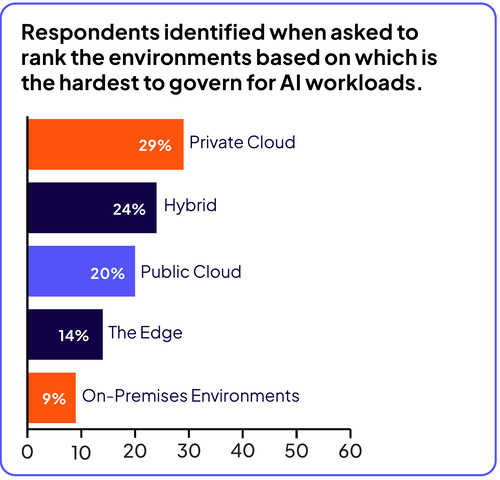 [Click on image for larger view.] Hardest AI Environments To Govern (source: Cloudera).
That complexity is coupled with frequent movement of data. Ninety-seven percent of respondents said they move data between environments at least monthly, while 31% said they do so daily.
The survey also found that 73% of respondents said AI has made data governance more complex. Cloudera linked the finding to the difficulty of applying consistent governance as data and workloads become increasingly distributed across cloud, private cloud, on-premises, and edge environments.
Hybrid AI Emerges Alongside Workload Repatriation
One of the survey's most cloud-specific findings was the movement of AI workloads. Sixty-six percent of respondents said their organizations moved AI workloads from public cloud back to on-premises or private cloud environments during the previous 12 months.
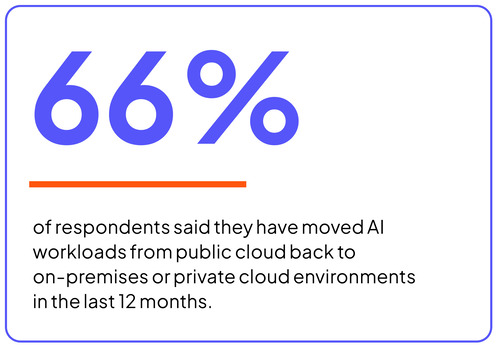 [Click on image for larger view.] AI Workloads Repatriated From Public Cloud (source: Cloudera).
The report does not characterize that finding as wholesale abandonment of public cloud. Hybrid environments were the most commonly cited location for AI inference workloads, at 31%, followed closely by public cloud at 30%. Private cloud accounted for 22% and on-premises infrastructure 8%.
Public cloud also narrowly led when respondents were asked which environment currently delivers the best performance for AI workloads: Thirty percent selected public cloud, compared with 29% for hybrid, 23% for private cloud, and 9% for on-premises infrastructure.
The follow-up Cloudera blog explicitly rejected interpreting the 66% figure as evidence of public cloud failure, instead describing it as an indication that organizations are taking a hybrid approach to workload placement. The results indicate organizations are choosing among environments according to factors including performance, governance, cost, latency, availability, and accessibility.
Plans for the next two years similarly point to investment across deployment models rather than movement in one direction. Greater cloud spending was the most common response at 29%, followed by more emphasis on a hybrid-first approach at 25%, greater on-premises spending at 24%, and greater edge spending at 22%. Just 1 percent expected no change.
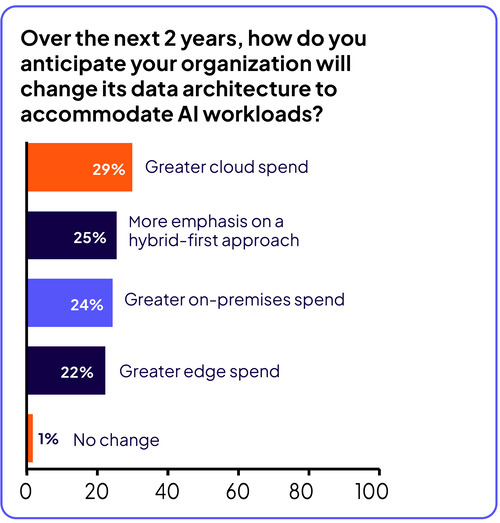 [Click on image for larger view.] Future AI Architecture Spending Plans (source: Cloudera).
Regional Results Show Different Cloud Mixes
The report also broke out results across the Americas, EMEA and APAC. EMEA respondents reported the highest rate of widespread AI use across their organizations and core operations at 47%, compared with 36% in the Americas and 30% in APAC.
The regions reported different infrastructure mixes. Public cloud use was highest among EMEA respondents at 38% and lowest in the Americas at 28%. Private cloud showed the opposite pattern, with respondents in the Americas reporting 27%, APAC 26%, and EMEA 19%.
Governance-related project disruption was reported across all three regions. Sixty percent of EMEA respondents said their organizations had delayed or canceled at least six AI projects during the past year because of governance, compliance, or regulatory issues, compared with 54% in the Americas and 50% in APAC.
There was also a regional difference in views of governance complexity. Eighty-one percent of respondents in the Americas agreed that AI integration makes data governance more complex and difficult to maintain, compared with 65% in EMEA and 61% in APAC.
Survey Methodology
Cloudera commissioned the research, which Wakefield Research conducted from June 5 through June 22, 2026, using e-mail invitations and an online survey. Respondents included 1,500 enterprise architects, cloud infrastructure leads, and data architects in the United States, Canada, Brazil, South Africa, Spain, the United Kingdom, Singapore, India, and Japan.
The full report is available here on the Cloudera site (registration required).