Gartner: Hypervisor Replatforming Is Reshaping Storage and Virtualization Decisions
Gartner's latest Magic Quadrant for Enterprise Storage Platforms points to a fundamental infrastructure shift: storage is becoming entangled with the upheaval taking place across enterprise virtualization.
The 2026 Magic Quadrant for Enterprise Storage Platforms says widespread licensing restructuring and pricing changes are prompting organizations to reconsider hypervisor strategies, creating what Gartner calls a "major displacement window."
That transition is changing storage buying decisions along with virtualization decisions. Gartner says IT leaders increasingly need to evaluate virtualization and storage platforms as a combined entity, with buyers prioritizing multihypervisor flexibility, container interoperability, and automated VM-conversion tools that can reduce the friction of moving workloads.
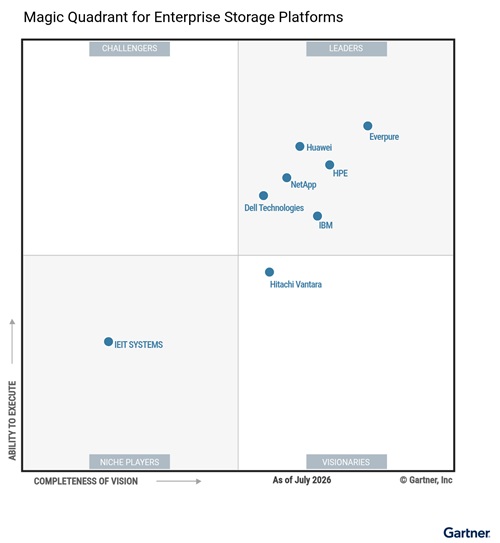 [Click on image for larger view.] Magic Quadrant for Enterprise Storage Platforms (source: Gartner).
Storage Joins the Hypervisor Replatforming Fight
Gartner specifically advises infrastructure and operations leaders to avoid storage platforms that tightly bind data to a single hypervisor. Instead, it recommends platforms that support hypervisor-agnostic deployment and VM-to-container migration across technologies including Red Hat OpenShift, Nutanix AHV, Microsoft Azure Local, and KubeVirt.
The guidance reflects a broader change in Gartner's definition of the enterprise storage platform itself. Rather than treating storage primarily as discrete block, file, and object products, Gartner now emphasizes a centrally managed control plane that unifies those workloads across on-premises and hybrid IT environments.
In that model, storage increasingly becomes part of the infrastructure operating layer rather than simply capacity attached to it — particularly as organizations redistribute workloads among virtualization platforms, containers, edge environments, and public cloud services.
Cloud-Style Economics Move On-Premises
Another major theme is the shift away from traditional storage purchasing. Gartner predicts that by 2029, consumption-based storage as a service (STaaS) will replace 50% of on-premises enterprise storage and data-services infrastructure capex, up from 25% in early 2026.
Gartner recommends moving sourcing toward consumption-based, service-level-agreement-backed STaaS models as a way to reduce exposure to hardware price inflation and technology obsolescence. In effect, more enterprise storage is being purchased and operated using the same pay-for-use and service-level principles associated with public cloud infrastructure, even when the hardware remains inside the data center.
That transition could be accelerated by what Gartner describes as an unusually severe storage cost environment. The firm says infrastructure leaders should budget for 250% to 300% of their 2025 storage spending in 2027 to accommodate rising memory and storage prices.
Gartner attributes much of the pressure to the rapid build-out of AI infrastructure, which has tightened supplies of silicon and memory components. It expects elevated costs and supply constraints to persist through at least 2028, increasing the importance of tiered architectures that combine flash, hard disk drives, and even tape.
That, in turn, makes intelligent data placement more important. Gartner sees automated movement of data across core, cloud, and edge environments becoming a key cost-optimization capability as organizations balance performance requirements against increasingly expensive storage media.
AI Pushes Storage Up the Stack
AI is another force changing the role of storage, though not simply because organizations need more capacity. Gartner says the performance bottleneck in accelerated computing is shifting from GPU compute toward the storage data layer, changing how enterprises evaluate storage infrastructure.
The firm expects 70% of organizations to deploy purpose-built AI storage tiers for large-scale inference and retrieval-augmented generation (RAG) by 2029, up from less than 10% in 2026.
Gartner also recommends bringing AI processing closer to stored data rather than repeatedly moving large datasets through extract-transform-load pipelines. It points to approaches that perform functions such as metadata indexing, semantic tagging, and vector generation directly within the storage environment, potentially reducing data movement, cloud egress costs, latency, and compliance exposure.
The result is a view of storage increasingly resembling an intelligent data fabric spanning core, edge and hybrid-cloud environments, with Gartner even citing emerging infrastructure metrics such as cost per token and tokens per watt-hour alongside traditional storage measures.
A Broader Platform Shift
Gartner identifies four forces behind what it calls an unprecedented transformation of the enterprise storage market: supply-chain volatility and costs, production-scale AI, hypervisor replatforming, and cyber-data resilience.
For virtualization and cloud infrastructure teams, however, the hypervisor shift may be the connective tissue among them. Moving workloads increasingly involves decisions about where data resides, how it moves between platforms, how storage is consumed, and how consistently it can be managed across on-premises, cloud and container environments.