Leading the Next Era of Internet2
A Q&A with Tripti Sinha
October marks the completion of Tripti Sinha's first year as president and CEO of Internet2. It is also Internet2's 30th anniversary, a milestone Sinha shares with the nonprofit networking and technology leader — She has been an active member of the Internet2 R&E community since its beginning, helping shape Internet2's foundational years, serving 30 years as an R&E community member (most recently as CTO at the University of Maryland), and shepherding Internet2's growing reach throughout the global R&E community today.
Here, we ask Sinha about meeting with the Internet2 membership and R&E community — but now as CEO; the achievement of this past year's strategic planning process; and the coming breakthrough technologies that she personally is most excited about as she leads Internet2 into the future.
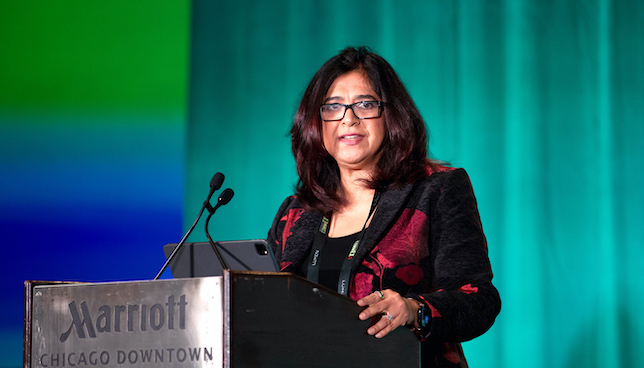 Internet2 president and CEO Tripti Sinha presenting a plenary session at one of this past year's R&E community events (Photo courtesy Internet2. With permission.)
Mary Grush: This month, October 2026, marks 30 years since the beginning of Internet2, an organization you helped shape and guide through those many years. And this week, on October 15th, it will be exactly one year since you took the helm as Internet2's CEO. What's in the nature of Internet2 that has made it research and education's trusted hyperscale backbone and a global R&E community leader?
Tripti Sinha: Internet2 was founded during a pivotal moment in the mid-'90s, shortly after the retirement of NSFNET, a National Science Foundation initiative that connected regional research networks with the nation's high-performance computing centers. And as the world recognized its power, the Internet started to become commercialized.
Higher education institutions came together and said, "Wait a minute! We don't want to use commercial infrastructure." Higher education required its own network backbone to serve the unique needs of research and education. That's the real story and genesis of Internet2.
So Internet2 began as a national backbone for research and education. But much has happened from the time it was first conceived to what it is today.
Internet2 began as a national backbone for research and education. But much has happened from the time it was first conceived to what it is today.
When Internet2 started, 30-some research universities came together to create a network exclusively for the nation's academic and scientific communities. Today, we serve not only universities, but also federal agencies, national labs, industry partners, and research partners. As of this publication date, we now have 517 Internet2 members, of which 352 are higher education members. Plus, there are 23 nonprofit affiliates, 34 federal affiliates, 62 industry members, and 46 regional R&E network members.
And today, beyond the network, we offer a whole suite of services, from identity, to security, to cloud and collaboration services and a federated trust fabric. These capabilities support the movement of massive data sets, access to high-performance computing centers and other resources, and seamless mobility services worldwide for the R&E community. Along the way, we've seen that technology has matured every three to five years — so something new always comes into play.
Grush: You've been part of Internet2's R&E community for most of your career. Over the past year, what was it like meeting with that community, but now as CEO? Was this "business as usual," or were there surprises along the way… What impressive things stood out?
Sinha: One way that Internet2 serves, beyond being a technology platform for the R&E community, is that it convenes this community so that we can innovate together. As a former technologist at the University of Maryland for more than 30 years, I'll say it's been a uniquely exciting and productive year coming into the role of Internet2 CEO.
For me it was certainly not business as usual. In my previous roles, I had looked at these interactions through the lens of an institution and a region. Now, I see my role with the perspective of serving the needs of the entire country, and indeed, even beyond. Research doesn't know national boundaries. We're connecting networks and communities across the Atlantic and Pacific to support international collaboration and discovery. I now have colleagues all around the world. My CEO role at Internet2 is about serving the research and education needs of a global community.
Research doesn't know national boundaries. We're connecting networks and communities across the Atlantic and Pacific to support international collaboration and discovery.
You asked me if there were any surprises or impressive experiences along the way. One thing that did stand out for me is that at Internet2, we do so much. The breadth and scope of this organization's mission is enormous.
As a technology-focused nonprofit, we've often led with the technology when telling our story. What I've come to see is an opportunity to tell an even bigger, more cohesive story that shows how our network, trust fabric, cloud access, and other services enable the work of our community. It's less about what the technology is and more about what it makes possible.
That was a striking takeaway from listening sessions with the community this past year. Our anchor events — like the Internet2 Technology Exchange and the Community Exchange (now Global Summit) — gave me valuable opportunities to meet with and listen to the community. Those conversations happened at an important moment, as financial pressures, a changing world order, and other shifts have impacted the entire R&E ecosystem. Listening underscored the urgency of our response and the next step: building a new strategic plan.
Grush: Your work on the strategic plan seems critically timed and very demanding… What are some of the modalities you've chosen for this work? What are some of the questions you're asking?
Sinha: It is definitely a critical time and the right time for us to embark upon this strategic planning process. We've engaged an outside strategic planning firm to help us with the process.
Of course, we've surveyed the community. We've had one-on-one conversations with different leaders in our community. We've had focus groups. And we're putting the plan together.
The plan will go back out for community comment once the initial blueprint is done, and I'd especially encourage CIOs and IT leaders to weigh in. Then it moves to the Internet2 board to ratify so we can start to act upon it. We're so excited about this plan because it's very comprehensive. It's not about isolated technologies, but how our capabilities can work together to support the needs of R&E.
It's considering the whole landscape along with feedback from the community. I have to say, the feedback has been wide-ranging. It's everything from How do we address the membership model, to How do we further advance the infrastructure and strategies we have in play? And How do we embrace emergent technologies in order to be ready to move forward?
As you know, Internet2 was initially created for very large R1 institutions. Today we're working toward parity in the capabilities offered across the nation's institutions, from big R1s to small colleges and under-resourced institutions. So, another important question is, How do we ensure that we can serve those who want to participate, with no barriers in place?
How do we ensure that we can serve those who want to participate, with no barriers in place?
And this is a time when we're bringing in new generations of leaders — CIOs and others — who may not have an understanding of why Internet2 was created and how its purpose has evolved.
All of these considerations will certainly be big factors in our soon-to-be-completed strategic plan and, ultimately, in the implementation work that follows. Much of that work is in how we tell the Internet2 story. Overall, we've seen that our current narrative is not hitting the sweet spot where people can truly understand it. We must not talk technology. We should talk enablement.
Our 2025 Annual Report is an early example of our approach, showing how Internet2 delivers value to our members and the broader R&E community. I encourage campus IT leaders to take a look at the published report on our Web site and see what we accomplished together this past year.
So with that, we're looking forward to the implementation of our new strategic plan.
Grush: What would you personally consider among the most exciting challenges and potential growth areas you've seen in the past year for Internet2? What are the areas you are most excited to lead, into the next year and beyond?
Sinha: This past year has been a critical junction for R&E and even for the world. Two frontier technologies — AI and quantum — are impacting our ecosystem in very complex ways.
Two frontier technologies — AI and quantum — are impacting our ecosystem in very complex ways.
Artificial intelligenceis in the news every single day. It's affecting us in all aspects of life, not just in our professional lives.
So, our challenge is, How do we leverage this technology to move the needle forward for research and education?
As an example, Internet2 recently collaborated with an industry member to build an AI-optimized network. And this is a very, very cutting-edge network built for a partner, spanning 3,400 kilometers. It connects five U.S. hyperscale data centers with a total capacity of 138 terabits per second. This is probably one of the fastest networks in the world for AI training and large language model development. The experience taught us how to optimize R&E networks to support AI at scale.
Beyond infrastructure we're also addressing the trust and identity implications of AI agents that can act on behalf of people and organizations. Through Internet2's InCommon initiatives, we're exploring how to create a framework to authenticate and authorize agentic AI as we've done for human identities.
And through our NET+ program, seven institutions recently worked together to vet a gateway service that reaches more than 250 large language model providers. And the whole R&E ecosystem can benefit from their effort.
I'm leveraging those experiences and asking, How do we, as a national player in AI stay ahead of the curve? How can we be ready when the technology is?
So that's one frontier challenge: all that encompasses AI in our R&E environment.
The second emergent technology that will affect virtually everyone is quantum. It's here today — it has been a significant technology on the horizon for many years, and now it's maturing more rapidly than ever.
Quantum may present a challenge at first, to understanding the complex physics behind what is the substrate of this technology. But on a practical level, we can explore quantum technologies in more familiar terms, like security.
In the security realm, NIST recently came out with a standard for PQC, post-quantum cryptography. We can apply PQC today to future-proof the encryption protecting our data against the arrival of quantum computers powerful enough to break current encryption methods.
Today, quantum computers are still very much in their early stages… but they're here. They're not yet solving complex problems in practice, but there will be a time — and I would say it's probably in the next five-to-ten years — when we'll see quantum-enabled scientific breakthroughs, for example, in climate studies, or in protein folding in biotechnology, or in precision medicine. I believe a time will come, sooner than we might think, when our quantum computers will be mature enough to solve complex problems in various fields.
A time will come, sooner than we might think, when our quantum computers will be mature enough to solve complex problems in various fields.
Quantum networking will certainly not replace the Internet. It will be an added feature of our existing infrastructure, where we are able to transmit information in a different form — in the form of qubits as just another representation of information.
If you take these two prevailing frontier technologies — quantum and AI — that are changing our world, and couple them with what's happening in the global world order, you will see why it's important to prepare now. The infrastructure we use, the underlying trust fabric, and how we collaborate across global regions will change rapidly, and soon. We need to be ready.
The infrastructure we use, the underlying trust fabric, and how we collaborate across global regions will change rapidly, and soon.
Grush: What should technology leaders be doing, to prepare themselves and their communities for many of the coming changes we've talked about today?
Sinha: Being a leader myself, I would say the most important thing is staying ahead of the curve, because right now the industry needs to mature, and that means change. An example of staying ahead of the curve is exploring a prominent technology — such as PQC. At Internet2 we've already started to test PQC on our network.
We completed a project recently, in Nevada, to test PQC with two of our industry partners, and demonstrated that it works. There are test beds all around the country. We are now working with our industry partners to see how we can play a role in connecting these test beds to facilitate networking across our backbone. We are building very strong ties with our industry partners so that when the technology is ready, I'm going to be able to go directly to the CIOs with solutions that work.
When the technology is ready, I'm going to be able to go directly to the CIOs with solutions that work.
Those are some of the ways in which we're preparing ourselves to be ready; to stay ahead of the curve so we can embrace the technology when it is ready.
Then what does the future of global R&E networks look like? It's complex. And it's hard to predict what it's going to be 5, 10 years from now, but I can tell you this: My colleagues around the world are committed to working together, ensuring that we keep doing what we need to do so that research advances and education is accessible to everyone.
What excites me the most, is looking ahead to what Internet2 will enable for the next era of science and technology.