Alternate Approaches
At the Wharton School of the University of Pennsylvania, technologists
have explored different types of innovations in interactive technologies for
synchronous communication, but one of their most successful undertakings operates
asynchronously, as faculty members and students see fit. These rich media efforts
revolve around a collaboration program called Webcafé, a glorified bulletin
board designed to facilitate collaborative study partnerships, as well as extracurricular
project planning for activities in and around the Philadelphia community.
The effort began back in 1998, as a portal for students in only 25 select classes.
By 2003, every student in the school’s 450 business and management classes was
given the opportunity to use it. Today, Webcafé is open to all students and
faculty members, plus some staff, with 7,500 concurrent users at any given time.
Rob Ditto, senior IT project leader, says Webcafé has become one of the most
commonly used technologies on Wharton’s campus, second only to e-mail.
To use the system, users simply log on with a standard Web browser, from wherever
they might be. Behind the scenes, Webcafé runs on software from EMC Documentum
(www.documentum.com),
an enterprise content management tool that helps users create and share any
number of files, including digital text documents, engineering drawings, still
images, audio and video files, and many others. Ditto says he wrote a separate
program that enables students to upload assignments to a secure server, and
allows faculty members to exchange comments with students in a secure environment
that stores the comments as part of a gradebook database. The software also
features more lifestyle-oriented collaboration spaces, which students use for
more practical purposes such as maintaining a database of summer sublets, or
voting on which stocks are the best bets for investment.
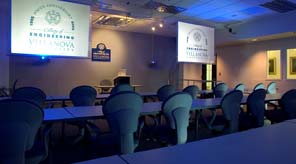
BANDWIDTH PROBLEMS don't impede distance
educators at Villanova, simple workaround works.
“For both students and faculty members, this simple approach really d'es enhance
everyday goings-on around Wharton,” says Ditto. “We found this was the best
way to build upon what happens in our classrooms.”
Because it is asynchronous, the Wharton solution addresses one of the most
prevalent stumbling blocks for rich media: bandwidth. Generally speaking, most
interactive technologies sap gigabytes of network bandwidth, so institutions
that run mission-critical applications on the same network may not have much
bandwidth left for the rich media apps.
Another element of the bandwidth issue revolves around student connections:
Streaming connections require 150 Kbps of bandwidth, or roughly one-third of
standard DSL line throughput. Short of requiring all students to have a connection
of minimum speed, there’s no foolproof way for a school to ensure that all students
are connecting at speeds that enable them to follow instructors in real time.
In most cases, when bandwidth is an issue on either side, at least some students
will experience five- or 10-second delays, effectively rendering the benefits
of rich media useless.
To ensure that bandwidth isn’t a problem for their students, technologists
at the College of Engineering at Villanova University (PA)
have whipped up a blend of old-fashioned technology and even more archaic transportation.
At the end of every distance education class, IT staffers help faculty members
wrap class materials into Zip files, usually no larger than 150MB. Next, depending
on a student’s connection, the staffers either make these Zip files available
for standard download, or they burn the files onto a CD-ROM and then spend $5
or $10 to overnight it via the US Postal Service. With this approach, Seán O’Donnell,
director of Distance Education, says that instead of downgrading quality to
serve the lowest common denominator, the school is able to respond to the individual
needs of students with all types of connections.
“We’re ready for anything,” he boasts. “But believe me, if you’re a distance
education student paying for one of our distance education classes, you wouldn’t
want to go into the race with a Pinto, you’d want a Porsche.”
Stumbling Points
As O’Donnell explains, schools can work to eliminate bandwidth as a problem
for rich media on campus. One obstacle that has established itself as a more
formidable challenge to the development of rich media is “educator comfort.”
According to IIT’s Kapp, educators in fields such as engineering and science
are comfortable enough with technology to explore new products as they come
out. However, in fields such as English and history, where educators don’t rely
on technology nearly as much or as frequently, Kapp says faculty familiarity
with rich media drops dramatically, necessitating a learning curve that can
debilitate a push for change.
In the latter cases, Kapp says faculty members are most likely to use rich
media to do nothing more than mimic the experience in the classroom. While these
educators might go through the trouble of hooking up a streaming videofeed during
lectures, the application won’t offer anything beyond this feed itself, a poor
use of rich media, by any standard.
One way to increase educator comfort levels with rich media is to make it easy
for instructors to take advantage of the technology as a way to supplement what
g'es on in class. At Drexel University (PA), for instance,
the school’s IT department launched what they call a “Rich Media Drop Box” to
automate the process of digitizing content to be used with interactive technologies.
The system hinges upon command line encoders from Sonic Foundry (www.sonicfoundry.com),
which cost about $20,000 apiece.
To use the system, faculty members drag and drop text, audio, and video files
into a special folder on the school network; the files are then transported
to an encoding farm, where they are converted into digital content that can
be used in just about any rich media environment. Access to this encoded content
is through RSS syndication. According to John Morris, Drexel’s coordinator of
Academic Technology and Web Services, the school processed more than 400 objects
during a recent 10-week pilot program with 10 faculty members.
“Once the faculty members learned that this made it easy for them to digitize
content, the Drop Box was something that really resonated with our faculty members,”
he says. “One way to ensure rich media is rich is to make it accessible for
everyone.”
Even with accessibility bases covered, rich media presents two other sizable
challenges for colleges and universities looking to increase interactivity across
the board. First is security—Villanova’s O’Donnell and a number of other rich
media experts say that a surprising number of students fall victim to issues
pertaining to firewall controls. The problems arise because at a time when identity
theft and other security threats are at an all-time high, few students have their
personal firewalls configured to allow incoming data to stream unchecked.
What’s more, when students log on to a rich media application, and their operating
system asks them if they want to allow the stream through the firewall, many
students decline because they are afraid of leaving their machines vulnerable
to attacks from elsewhere on the Web.
Perhaps the biggest challenge with rich media is the way a school uses it to
support human cognition. Mayer, the UCSB psychology professor who also authored
the recently released Cambridge Handbook of Multimedia Learning (Cambridge University
Press, 2005), has studied the cognitive science since 1995, and insists that
there’s a huge difference between a technology-centered approach and a learner-centered
approach.
In theory, Mayer says that rich media can be a valuable tool. In practice,
however, he insists that few, if any, schools actually use the technology the
way they should. Looking forward, Mayer notes that in order for rich media to
be more than just a fad, inventors must devise a way for users to rely upon
rich media for something that extends and amplifies the ordinary classroom experience
without detracting from it at all.
“We’re not even close to seeing rich media that, for lack of a better word,
is rich,” he says. “The technology has the opportunity to revolutionize learning,
but if it’s developed poorly, we will turn off more people than we attract.”