A Model for Student Success
The multi-institutional PAR Framework project provides a valuable resource supporting predictive analytics for student success and linking interventions to specific risk factors.
|
Category: Student Systems and Services
Institution: PAR Framework
Project: Predictive Analytics Reporting Framework
Project lead: Beth Davis, managing director, PAR Framework
Tech vendors/partners:
|
The PAR Framework's first priority is to develop principles and practices for scalable improvements in student success, based on collaborative data and research. The member-supported, not-for-profit analytics-as-a-service provider has built predictive models using a very large, shared data resource, capable of identifying risk all the way to the individual student. PAR is distinguished among the many data analytics projects emerging in the education domain by its common, openly published data definitions.
Higher ed leaders explain the origin and mission of the PAR Framework. (Video courtesy of PAR Framework) |
PAR began in 2011 as a research program with Bill & Melinda Gates Foundation funding, administered by WCET, that brought together an initial group of six higher education institutions to contribute to the development of a single federated dataset — with the goal to use predictive analytics to solve student success challenges. Since its inception, the program has grown to include more than 20 member institutions. The dataset is built (and is still growing) with more than 1.8 million normalized, de-identified student records and provides a unique multi-institutional resource for researchers to examine real-world research questions about student success and promote the best intervention practices.
Moving well beyond its initial project phase, PAR is on track to become a standalone 501.c.3 nonprofit organization by the end of this year. "We believe the time is right to establish a not-for-profit practice-improvement center that supports using learning analytics in the service of student success," said project lead Beth Davis, who is co-founder and managing director for the PAR Framework.
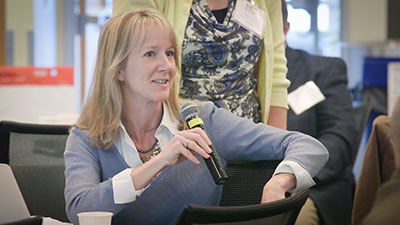
PAR Framework Managing Director Beth Davis (Photo courtesy of PAR Framework) |
PAR will continue as a collaborative venture of member institutions, and maintain its practice of openly licensing resources for use by other higher education institutions. Past examples of its policy of openness include the PAR Framework Data Model, released in February 2013, and the Student Success Matrix (SSMx), released in July 2013. The SSMx and the PAR common data definitions are available at https://community.datacookbook.com/public/institutions/par.
The PAR Framework's technical requirements include distributed collaboration, data collection, analytics and reporting. Member institutions contribute student and course data to a common dataset hosted on Amazon Web Services, with rigorous quality assurance before incorporation. PAR uses iData Cookbook for documenting and publishing the data definitions, and data are visualized in SAS Visual Analytics to affordably provide unlimited online partner access to state-of-the-art visualizations. Going forward as a grant- and membership-funded nonprofit entity, PAR will use open source tools (when possible) and/or common tools for the ease of sharing project information.
The PAR dataset was envisioned specifically to support research on student success, but evidence has shown that it has the potential to impact many areas of higher education institutional strategy and decision-making. As Ellen Wagner, PAR's chief research and strategy officer, noted, "One of the new dimensions you may see in the future comes from PAR's ability to respond to some of the bigger national policy questions that come up — conversations around topics like performance-based funding and online learning efficacy. PAR is already starting to provide some interesting insights in the area of decision support, in states where funding is being tied directly to outcomes. And PAR is giving institutions a chance to do comparative studies to examine their place among peers."
|
For more information on the Campus Technology Innovators program, visit the awards site.
|
About the Author
Meg Lloyd is a Northern California-based freelance writer.