Recruitment Marketing Calls for Smarter Spending
- By Linda L. Briggs
- 02/26/09
Social networking sites, primarily Facebook and MySpace, offer some interesting marketing possibilities for higher ed. But which sites to use, and in what ways? In this second half of a two-part interview with higher education marketing expert Bob Johnson (part 1 here), we asked Johnson how best to spend limited marketing dollars, and what role--if any--print still plays.
Johnson, who consults on issues around online marketing in higher education, blogs regularly at bobjohnsonblog.com and posts a weekly link to a noteworthy college or university Web site here.
Campus Technology: Let's talk about using social media for marketing. There are a number of choices out there. Facebook, MySpace and even LinkedIn are all possibilities. What's the best strategy?
Bob Johnson: If you're talking about general recruitment, I would forget LinkedIn for your general undergraduate population. LinkedIn is a possibility for certain kinds of specialized masters-level programs that appeal to working people. But, in general, if you're mainly interested in the undergraduate population, you need to look at Facebook or MySpace or both.
Part of the difference is demographics. The Facebook audience is a little more affluent, a little more male, a little better educated by family background. The MySpace crowd is somewhat the opposite....
I think you need to pick an initial site that most closely fits the demographics you're interested in, develop that, and see what happens. The most important thing in developing a site on [Facebook or MySpace] is not to close off the ability of people to respond and to add content directly to the site. For instance, Facebook has the "wall" where people can write comments. Some colleges and universities turn that off because they're afraid that people will write not-nice things about them. If you're going to do that, you might as well not do Facebook at all, because that goes against the whole grain of what a site like that is for.
CT: You mentioned LinkedIn. What are some differences between recruiting traditional students right out of high school or aiming at the adult market, which is popular during a recession?
Johnson: Let me cite from a new Pew Internet survey called Pew Internet on Adults and Social Media that I recently blogged about.
According to the study, 57 percent of adults from 25 to 34 maintain their own social networking sites, and 75 percent of adults 18 to 24 do. That's essentially people still in college. But consider that 57 percent of adults from 25 to 34--that's prime recruitment territory for adult students, masters programs, and things of that sort. That percentage is only going to go up. The percentage above age 34 goes down pretty quickly.
CT: So Facebook and MySpace are still good choices for that age range.
Johnson: Again, people in higher ed tend to gravitate more immediately to Facebook and look down their noses on MySpace a bit. There's information out there about the demographics of each group. You need to look at it and make a realistic decision about which one is best for you. In the case of Ohio State, they maintain both. It's a mega-sized state university, and they have such a wide range of people attending that they probably looked at this and said, "We've got to do both because we've got people all over the spectrum."
For the working professional, LinkedIn is a good source. It's much smaller in terms of participants than MySpace or Facebook, but it's an entirely different kind of site. It's much bigger than Twitter right now, but I don't know if it will stay that way.
CT: LinkedIn offers targeted advertising, right?
Johnson: Yes, it's a direct marketer's dream, at least in terms of testing it to see what happens. Most people have enough money in their budget to first test without going whole-hog.
CT: Let's shift gears a little bit. As you talk to colleges and universities, what's the single biggest marketing mistake you see being made out there?
Johnson: That's tough.... If we stay with the online discussion, I'd say that they're putting much more attention into things that get people to visit them online--advertising and so forth--but not enough attention to how the experience continues when [students] actually get to the Web site. I did a posting recently about a new University of Phoenix campaign that's discusses exactly what I'm talking about.
You put all the money in the upfront creative, which is fantastic in the University of Phoenix campaign, I thought--just really, really good. They had a good landing page to respond to the ad, which is where a lot of schools falter and don't spend the money. Phoenix did [well there], but, as you move further along, it just starts to break down. It's a failing of integrated marketing online. They're creating initial interest, but then losing that interest because the experience people have when they visit the Web site isn't strong enough. It doesn't capture them enough.
I think colleges and universities aren't paying enough attention to what the potential students want to find and want to do on their Web sites. I click on lots of online ads [for higher ed] to see where they go. Generally, the first step is good, but after that, they tend to fall apart.
Here's a good example. We just did a ... program for a university in Canada where we surveyed their audience on what was important to them on the Web site... One of the things that most people want to find on a college and university Web site is this: They want to be able to go in and learn what the school is going to cost. We're not talking about the sticker-price of tuition, although even that can be hard to find. They want to know the bottom line....
Colleges and universities for the most part do a wretched job of giving people access to that information, especially in this economic climate.
One that does a really good job is the University of Toledo. On my blog, I've listed schools that have scholarship and financial aid estimators on their sites. I think the University of Toledo has had one for three or four years. It's marvelous the way it works.
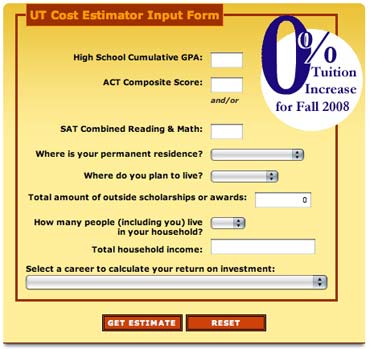 The University of Toledo's online cost estimator
CT: In your blog, you note that there are many more of these online calculators than there used to be.
Johnson: Remember how people are searching now. The recruitment world has been overcome in the last five years with this idea of stealth applicants and stealth inquirers. People are searching online for information about colleges and putting together their groups of five or 10 schools that they'd most like to consider, but they never identify themselves to the schools. They have no need to. So schools are sitting there with cartons of viewbooks ready to send to people when they fill out online inquiry cards, but they never [fill them out]; that's true at every school I've talked to.
CT: That speaks to spending time and energy in making sure your Web site is just what you want it to be.
Johnson: Yes--and not having financial information [readily available] is a major marketing mistake.
On another level, there's still a real imbalance between the amount of recruitment resources spent on publications and the amount spent on online efforts. I think you're going to see that start to change dramatically now as colleges have to make reductions in their operating expenses. But the last number I saw ... the average reported part of a budget spent on print publications [for recruiting purposes] was 24 percent, and the amount spent on online recruitment activity was 11 percent.
CT: Is there still a role for print marketing in reaching a younger audience?
Johnson: I think there still is. Let's put it this way. If you had to do one or the other, the answer is pretty simple. You do online. But it isn't that simple, unfortunately. The percentage of students who say they prefer to get their information online is increasing, but the percentage who say they also want to get information in print is still in the 40 percent range someplace.
While the needle is moving, it hasn't moved so far that you can completely throw away print. I think the traditional viewbook is going to become a photo essay book about the institution. So far, the impact from big photos is one thing that you can't copy online on a Web site yet.
But if nothing else, inquiry pools are shrinking.... Imagine the traditional viewbook. It used to be sent to people when they made an inquiry at the start of the exploration process. It was never meant to be sent out the door to somebody after they've sent you an application. Well, today the inquiry pools are going down even when the application pools are going up.
I think there is still a role for print, but I think it's going to be a shrinking role; and, when you have to start to make hard choices that you didn't have to make a year or two ago, that's going to move the budget toward online. A lot of schools have got to get their online presence stronger, and they're not going to get new money to do it.
CT: We've talked about some of the big mistakes you've seen out there. Can you name some schools that are making good use of technology and marketing?
Johnson: The University of Toledo [with its financial aid estimator] is one example, and there are more schools moving to let people find serious information online about cost. I think that's a great use of technology.
Mt. Holyoke College alumni people have done a really nice job putting their print alumni magazine online using a blog format. They put each individual article up as if it was a blog entry, and list the article separately.... They're not getting many comments, but ... they know people are reading the articles--and long after they're first put up online, which says [readers are] using a search tool to come in. And they still produce the print magazine. That's a good, smart use of technology.
Another good example would be schools creating their own social networking sites. Edmonds Community College ... has created their own version of MySpace or Facebook. It looks a little more like MySpace. They have a marvelous array of things that people can do on that site. That is a really smart example of grabbing what's popular out there.
Also, Northwestern Law School in Chicago has got a very nice interactive online viewbook (PDF here). I use that as an example all the time. It's got video on it.
Video is increasing all the time in importance on Web sites and you'll see more and more of it. People are using the new technologies for online campus tours, for example. Mt. Holyoke College has a marvelous example of that. Agnes Scott College has a marvelous example as well.
They're using the online tour sites to introduce people at the schools to the people who come to take the tour online. It used to be all you got to see were buildings and grounds. Now, you get to meet people. That's a very smart use of technology because ultimately ... that's the second or third most important thing that people most want to know about a college or a university: what kind of people are there. The last thing in the world that people want to see when they go on a campus tour is the outside of buildings. They want to see people and they want to hear from people.