Mississippi State Students Design Android Phone Games
- By Dian Schaffhauser
- 03/01/10
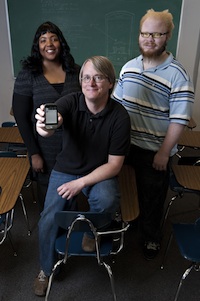
Mississippi State students and game designers John van der Zwaag (front), Natasha Pittman, and Keni Steward, are working on programs to run on the HTC Hero smartphone. |
A dozen students in Mississippi are working with a cellular carrier to develop smartphone games that will eventually end up in the Google Android Market. The students, enrolled in a game design class at Mississippi State University, are working with Cellular South to create computer games for the HTC Hero. The training is provided through the Bagley College of Engineering's department of computer science and engineering.
Ed Swan, an associate professor teaching the course, said cell phones have "become, by far, the most rapidly disseminated technology in the history of mankind; almost half the world population has one." Since one mobile phone is sold for every two people in the world, the college's incorporation of smartphone game design into its teaching curriculum "seemed like a no-brainer," he added.
According to comScore, as of December 2009, Google had 5.2 percent of the smartphone device market, which also includes the Apple iPhone and RIM BlackBerry, among others. According to AndoLib.com, a search engine for Google Android applications, the market has about 31,000 applications and games, of which games make up 15 percent. Free programs make up about 62 percent of the market. Programs for purchase typically cost just a few dollars.
"The partnership between Cellular South and the MSU class is good for a number of reasons," Swan said. First, the open-source Google Android operating system is available for no cost; second, the cellular carrier provided phones that allow the students to demonstrate their games on the devices.
Swan said class members will have opportunities to design two game applications for the Android phone.
About the Author
Dian Schaffhauser is a former senior contributing editor for 1105 Media's education publications THE Journal, Campus Technology and Spaces4Learning.