AV & Presentation | News
Crestron Ships Flash-Enabled AV Touchpanel
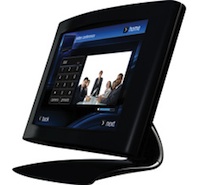
Crestron's TPMC-9 is a touchpad AV control system running on the Core 3 OS. |
Crestron has rolled out a new wireless touch panel that controls AV applications, room temperature, and lighting conditions, while offering support for control applications and Adobe Flash objects.
To support applications and Flash objects, the panel, dubbed the TPMC-9, uses Crestron's Core 3 OS, an operating system with the ability to run up to ten programs simultaneously. The operating system offers a desktop that can be customized by changing themes or adding animated clocks, weather widgets, and news feeds.
Control applications supported by the operating system have the ability to be layered into a single programming object that scales its size to match that of most iOS and Android devices.
The TPMC-9's interface is a 9-inch touchscreen with a resolution of 800 x 480, a brightness of 350 cd/m², and a contrast ratio of 700:1. The interface offers 16-bit color and a viewing angle of 88 degrees both horizontally and vertically.
The TPMC-9 supports gesturing control for lighting, AV networks, thermostats, and other connected systems while offering both cover flow and page flip animations.
For wireless control, the device ships with infiNet EX, an RF-based technology that allows the TPMC-9 to connect to devices at maximum distances of more than 200 feet.
Other features include:
- IP over Ethernet and integrated video that can be connected to a camera by wire or streamed using the M-JPEG standard;
- 256 Megabytes of RAM;
- 2 GB flash memory;
- USB port; and
- The ability to load WAV files for use as personalized button feedback and voice prompts.
The TPMC-9 is available in gloss black, matte black, and gloss white.
Further information is available here.
About the Author
Dan Thompson is a freelance writer based in Brea, CA. He can be reached here.

