Optoma Launches 3D Projectors with HD Resolutions
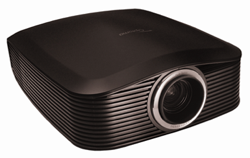
The Optoma HD8300 has a contrast ratio of 30,000:1 and a brightness of 1,500 lumens. |
Optoma has released three DLP projectors that work in conjunction with active RF-3D glasses to reduce line of sight problems and synchronization issues that can occur when 3D content is viewed using active infrared technologies.
The new projectors, dubbed the HD8300, the HD3300, and the HD33, are single chip DLP models with native resolutions of 1,920 x 1,080 (1080p) and vertical keystone corrections of +-5 degrees.
The HD8300 has a dynamic contrast ratio of 30,000:1 and a brightness of 1,500 lumens while the HD3300 has a contrast ratio of 5,000:1 and a brightness of 2,000 lumens. The HD33 features a brightness of 1,800 lumens and a contrast ratio of 4,000:1.
The HD33 and the HD3300 use a 1.2x zoom lens and a 230-watt bulb to display standard or 3D images with a maximum screen size of approximately 300 inches while the HD8300 uses a 1.5x zoom lens and a 280-watt lamp to create a diagonal image size that ranges from 29.8 inches to 297.3 inches at distances between 4.9 feet and 32.8 feet. The estimated lamp life of the 230-watt bulb and the 280-watt bulb is 4,000 hours.
AV ports of the HD33 and HD3300 include two HDMI, analog RGB/component (mini D-sub 15-pin), component video, composite video, a 12-volt trigger, and VESA 3D, a port for active 3D glasses. Peripheral and control ports include RS-232 and USB. The HD8300 is equipped with all previously mentioned ports and an additional 12-volt trigger.
The HD8300 and the HD3300 are covered by a 3-year express replacement warranty and a 2-year lamp warranty. The HD33 is covered by a 1-year parts and labor warranty and a 3-year express warranty.
The HD3300 and HD8300 will ship in late August for $1,999 and $4,499 respectively. The HD33 is currently available for $1,499.
Further information can be found at optomausa.com.
About the Author
Dan Thompson is a freelance writer based in Brea, CA. He can be reached here.