GeoScavenge Introduces New Frosh To USC Campus
Original reporting by Susan Bell/USC Dornsife Communication
At
lunchtime
on August 22, during Welcome Week and orientation for freshmen at the University of Southern California (USC), there were still a lot of things Sidrah
Khan and her new friend Jennifer Wang did not yet know about their new
school.
A
couple of hours later, however, thanks to the first-ever USC
GeoScavenge, she
knew where to go to get a flu shot, how to get a shuttle bus to the
other side
of campus, where the most affordable lunch could be found and what
astronaut
Neil Armstrong had said about the future in his 2005 commencement
speech.
That
was
the day Khan, Wang and about 40 other new USC freshmen loaded a QR code
reader
into their smartphones, started out at the statue of Tommy Trojan at the
center
of the campus and headed off on a scavenger hunt. Using a GeoScavenge
map,
accessible on their devices via a QR scan, they got clues about where to
look
for the next location on the hunt.
| |
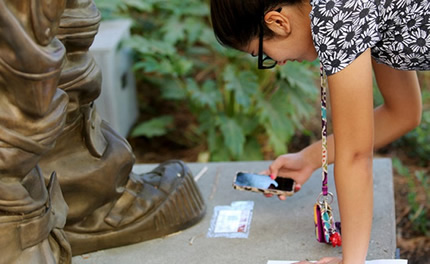
Students in the USC GeoScavenge used QR codes to get clues and answer questions about sites on the USC campus. |
|
Once
there,
they had to answer multiple-choice questions about it before moving on
to the next clue.
The
point?
To help new students get acquainted with their new classmates at the
same time they learned some valuable information about their new school.
The
idea
came from the university's Spatial Sciences Institute, which passed it
on
to Melissa Turk, associate director of orientation programs, who said she was
happy to
add the hunt to the other Welcome Week activities for new students.
"The
GeoScavenge
is a perfect fit for us," Turk said. "Students get the opportunity
to learn the campus on their own. Plus, all these places are now tagged
in
their phone so, if they get stuck, they have all that information at
their
fingertips."
Darren
Ruddell,
assistant professor of spatial sciences, said, "We hope students will
look at the map and think about routing — What would be the most
efficient
route to visit all 23 clues and get back to Tommy Trojan as quickly as
possible?"
At
the
end of the hour, prizes — USB drives and water bottles — went to the
four-student teams who got to the most destinations. Khan and Wang also
knew
what Armstrong had said about the future nine years earlier: "I do not
know,
but it will be exciting."
And
Ruddell
even might have gotten a few new students interested in a couple of his
department's courses on spatial mapping.
About the Author
Michael Hart is a Los Angeles-based freelance writer and the former executive editor of THE Journal.