Stanford Offers Online Program in Design Thinking
The Stanford
Center for Professional Development will now
offer its program on design thinking and team-building via a series of
interactive
online videos.
The Stanford University program allows
participants,
colleagues in companies or organizations, the chance to work face to
face in
live workshops, explore engineering and design methods pioneered at
Stanford and
come up with their own principles and tactics for improving design
thinking.
 Perry Klebahn and Jeremy Utley, directors
of executive education
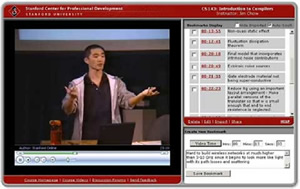
at the center, will conduct each online workshop. The workshops are a
series of
interactive online videos in which Klebahn and Utley lead participants —
watching the videos together from their own workplace — through hands-on
exercises
in which they use real challenges from their own organizations.
Perry Klebahn and Jeremy Utley, directors
of executive education
at the center, will conduct each online workshop. The workshops are a
series of
interactive online videos in which Klebahn and Utley lead participants —
watching the videos together from their own workplace — through hands-on
exercises
in which they use real challenges from their own organizations.
With the online program, participants are
encouraged to move
around the rooms they are in — take risks, try new behaviors — and work
together to generate creative solutions.
A companion workbook includes tools and
step-by-step
instructions that, in conjunction with the online video series, is designed to
help
organizations build environments in which ideas and inspiration are
encouraged.
The Stanford Center for Professional
Development is an arm
of Stanford University that provides working professionals with access
to
research and teaching in the School of Engineering and related academic
departments. Qualified individuals not only have access to programs like Stanford
Innovation at Work but also master's degree and certification
programs.
Anybody interested in learning
more about using design
thinking tools can participate in the program's first webinar,
"Analogous
Inspiration: How to Get Great Ideas From the Most Unlikely Places,"
Monday,
November 3 at 10 am Pacific.
For more information or to enroll, go to innovationatwork.standford.edu.
About the Author
Michael Hart is a Los Angeles-based freelance writer and the former executive editor of THE Journal.