U of A Preps Classroom Spaces for Active Learning
The University of Arizona is preparing for a massive
initiative to implement active learning in several courses next fall.
With a grant from the Association
of American Universities,
the Tucson, AZ campus is overhauling several classroom spaces to
accommodate
active learning in environments that will vary in size once the fall
semester
begins.
Once construction that begins in May is completed, a
classroom
space in the Science-Engineering Library will have a capacity for 260
students
while another in the Biological Sciences West building will accommodate
112 and
two more in the Integrated Learning Center will provide room for 60
students
each. A fifth space is being scouted as well.
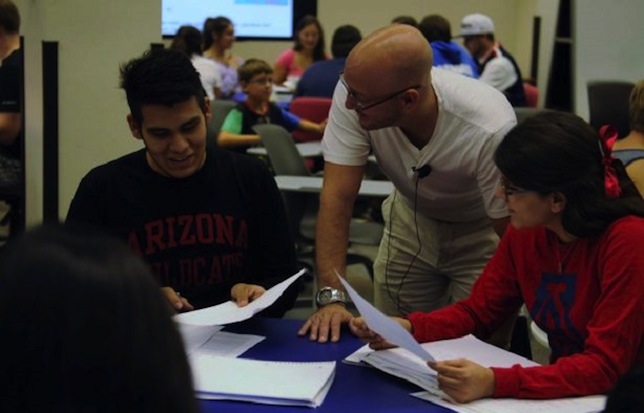
"We want a variety of sizes, as well as a variety of
locations
across campus," said Jane Hunter, an associate professor of practice
with the
university's Office
of Instruction and Assessment. "By distributing these rooms
around campus, we like to believe that people will see them and say, 'I'd like to
do that.'"
All of the classroom spaces will move from being the
kinds of
rooms in which a lecturer stands at the front of the room to ones in
which
students will sit at tables of, at the most, six in an effort to enhance
engagement. Each will also be supplied with banks of computer monitors,
tabletop and A-frame whiteboards and other kinds of "high-touch" technology.
"I was ready for a space like this before it
existed," said
Susan Jorstad, who will teach an introductory course in molecular and
cellular
biology in one of the spaces in the fall. "I've been doing
active-learning
things all along, but in a space that's not very conducive to it."
A faculty learning committee is preparing two
workshops to be
held during the summer for instructors who will use the active learning
spaces
in the fall and a webinar featuring the UA project will be offered May
5.
"These rooms are like a catalyst for those who have
been
thinking about modifying their teaching strategies," said Hunter. "The
innovators,
the early adopters, they want to be in on this."
About the Author
Michael Hart is a Los Angeles-based freelance writer and the former executive editor of THE Journal.