Report Pegs Cost to Develop an OER Course at $11,700
- By Dian Schaffhauser
- 10/12/18
According to a recent research project, developing an open education resources course costs, on average, about $11,700, to cover salary and benefits for the instructors involved. OER courses produced by individuals were half the price of those created by teams ($8,900 vs. $18,200). As the report covering the data noted, teams provided both benefits — greater confidence in course quality and faster time to course completion — and hurdles: They also took more time to coordinate the work, sift through team materials, review and comment, and work toward consensus.
Those are a few of the results that came out of an extensive study examining the implementation of OER in colleges. The work was commissioned by Achieving the Dream, a national nonprofit that works with a network of community colleges to help students succeed. Achieving the Dream has been running an "OER Degree Initiative" in 38 colleges over the last couple of years, and this latest report was meant to capture a snapshot of findings to date. The research was undertaken by SRI Education, a division of research company SRI International, and education consultancy rpk Group. Data for the entire project came from 2,441 student surveys given across 12 sites, as well as site visits to 11 colleges, where numerous individuals were interviewed (including 51 administrators, 25 faculty members and 68 students) and classroom observations were performed. Cost data associated with developing OER courses and pathways came from five "cost partners," and additional cost information was collected from the 32 OER Degree Initiative schools.
The OER Degree Initiative has helped to grow the number of OER courses from 13 in 2016 to 385 in spring 2018. During that time, participating colleges saw a 10-fold increase in students enrolled in OER courses, with 37,398 students enrolled in 2017 (up from 3,404 students in 2016).
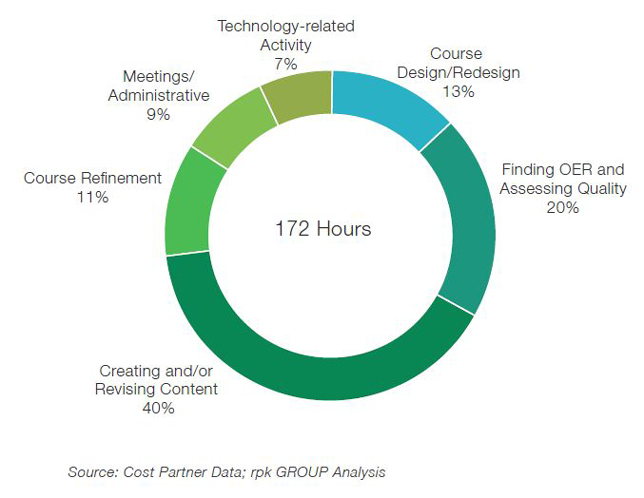
Costs of developing OER courses, overall. Source: "Participant Experiences and Financial Impacts: Findings from Year 2 of Achieving the Dream's OER Degree Initiative."
Based on time logs maintained during development of OER courses in the cost partner institutions, researchers found that an OER course required an average of 172 hours to build. The bulk of that time was dedicated to two types of activities: finding and assessing OER quality (20 percent) and creating or revising the content (40 percent). As might be expected, the team approach to content creation and revision took longer than it did for individuals (46 percent vs. 35 percent), but teams also spent less time on course design and redesign.
The report observed that the cost of creating OER courses could eventually shrink as processes become more efficient. For example, some schools reported using librarians to search for OER materials or encouraging their instructors to adopt existing OER courses rather than creating their own.
Interestingly, courses that used open textbooks, such as those from OpenStax, are just as expensive to set up as those that rely on multiple sources curated by faculty. As the report noted, "Some instructors used open textbooks as a starting point and proceeded to make extensive revisions, often devoting significant time to finding better images, illustrations, and videos to incorporate, which increased average development costs." Instructors also needed to devote time to creating homework questions, assessments and related activities, which often aren't part of OER textbooks.
The development process also led to changes in some — but not most — pedagogical practices. According to instructors in several of the colleges, the use of the OER content let them "align materials better with their learning goals." Several instructors said that students were more engaged with OER materials compared to textbooks, because they were better tailored to good pedagogy and reading materials were more contemporary and relevant.
The same project also examined the impact on bookstore revenue. Because so many students already didn't purchase books in the campus bookstore, the revenue loss caused by the shift to OER was nominal — about $11,200 on average per institution for the second year in which OER courses were offered, or just 1.7 percent of the typical bookstore revenue stream. While the impact was "expected to grow" as OER enrollments increased, the report's authors added, even then, the overall effect on schools would be tiny, since bookstores tend to contribute less than 1 percent to total institutional revenue.
Although the schools that were part of the research project all enjoyed grant funding to support their OER efforts, sustainability — and scaling — of that work became a big focus as the grants were winding down. Five of the grantees implemented "OER course fees," which were sometimes passed directly onto vendors in those cases where the schools used external providers to supply access to OER materials. In other environments, where it's harder to introduce new fees, schools might have an easier time using technology or online fees to support OER efforts, the report suggested.
Eventually, schools might be able to justify tapping the extra tuition generated through improved student performance and retention for funding of OER development. However, the report emphasized, "It is too early to make this claim." Institutions are just beginning to track "tuition recapture" based on the decline in attrition in many of their OER courses to better understand the return on investment associated with OER.
"OER has real potential to help students both academically and financially, but if it is to succeed, institutions need to have a real understanding of what it takes to implement OER degree pathways," said Rebecca Griffiths, a principal education researcher in SRI International's Center for Education Research and Innovation, in a statement. This report, she added, "outlines key considerations colleges need to make if they are seeking to pursue OER degrees."
Funding for the $9.8-million research project came several sources, including the William and Flora Hewlett Foundation, the Bill & Melinda Gates Foundation and Great Lakes Higher Education Corp. & Affiliates.
The full report, "Participant Experiences and Financial Impacts: Findings from Year 2 of Achieving the Dream's OER Degree Initiative," is available on the Achieving the Dream website.