Report: AI Skills Boost Wages for Some, Redefine In-Demand Occupations
Artificial intelligence is providing a boon for many occupations, with AI skills often bumping up paychecks, according to PwC's 2024 Global AI Jobs Barometer report. The professional services consultancy analyzed over half a billion job ads to reveal the transformative impact of AI on job growth, skills demand, wage premiums and productivity across various sectors.
It's a mixed bag, as demand for some jobs in sectors like IT — especially software development — has gone down as employers seek to automate tasks, while demand for AI-related jobs has risen.
The bottom line: Jobs requiring AI skills carry up to a 25% average wage premium in some markets.
Other takeaways from the report include:
- Sectors with highest AI penetration are seeing almost fivefold (4.8x) greater labor productivity growth. Rising labor productivity can generate economic growth, higher wages, and enhanced living standards.
- Growth in jobs that require AI specialist skills has outpaced all jobs since 2016 (well before ChatGPT brought fresh attention to AI), with numbers of AI specialist jobs growing 3.5 times faster than all jobs.
- Skills sought by employers are changing at a 25% higher rate in occupations most able to use AI. To stay relevant, workers in these jobs will need to build or demonstrate new skills.
The finding that workers possessing specialized AI skills earn substantial wage premiums indicates that their capacity to implement AI is highly valuable to companies, PwC said.
"AI's value to companies is made clear by what is happening with the wages of workers with AI specialist skills — the very people who are making the AI revolution possible," said the report. "As we have seen, growth in jobs demanding AI specialist skills has outpaced growth in all jobs since 2016. What's more, these jobs carry up to a 25% wage premium on average, underlining the value of these skills to companies."
On the high end of those wage premiums for job vacancies that require AI skills are database designers and administrators (53% in the U.S.), while accountants with AI skills command only an 18% premium in the U.S.
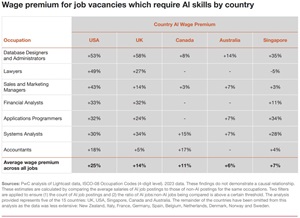 [Click on image for larger view.] Wage Premium for Job Vacancies Which Require AI Skills by Country (source: PwC).
Meanwhile, some occupations are seeing less demand, as they are easily susceptible to disruption by AI systems.
For example, while demand for AI-related skills like AI/ML inference have skyrocketed (113% growth), the software development field has been shaken up by coding assistants like GitHub Copilot, with even general-purpose AI chatbots like ChatGPT increasingly being used to generate code. That resulted, for one example, in JavaScript skills seeing a 37% decrease in demand.
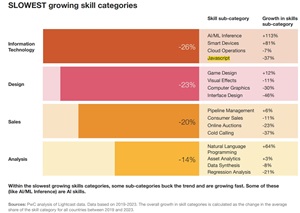 [Click on image for larger view.] Slowest Growing Skill Categories (source: PwC).
"AI is redefining what it means to be a financial analyst, a software coder, a customer service agent (and many more roles), opening up whole new possibilities for workers to deliver impact," PwC said. "Workers who learn to harness AI are likely to have bright futures in which they can generate greater value and could consequently have greater bargaining power for wages — all within a context of rising societal prosperity."
Workers should embrace AI, develop sought-after skills that complement or challenge AI, and adapt to succeed in an AI era, the report said. Companies and policymakers share the responsibility of supporting workers in this transition.
Key areas of action to provide that support for those businesses and policymakers include:
Businesses:
- Embrace, experiment and pioneer new uses of Al. Think beyond using Al to do existing tasks. Instead, pioneer new ways to create value.
- Build a climate of confidence and trust in using Al so people are more likely to welcome trying it.
- Use Al to complement people. Figure out where Al is best used in partnership with people.
- Hire on the basis of skills rather than only degrees or work history.
- Upskill workers to make the most of Al.
Policymakers:
- Encourage the use of Al to grow productivity and prosperity.
- Ensure growing prosperity from Al adoption is widely shared.
- Support the use of Al to augment rather than replace workers.
- Support workers with training/retraining, worker protections, and safety nets.
- Shape the education system to help prepare workers for an Al age.
The company said its Responsible AI framework can help with both of the above.
"PwC's analysis of over half a billion job ads worldwide suggests that AI may help make workers more productive, opening the door to rising prosperity for workers and nations," the report said in conclusion. "Like past technological revolutions from electricity to internal combustion engines, AI is changing what it takes for workers to succeed — and those who adapt may enjoy vast new opportunities."
The full report is available on the PwC site.