Higher Education Researchers Meet at Microsoft Summit
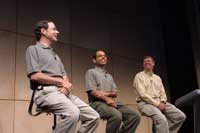 Bill Gates gave the opening keynote Monday at Microsoft Research's 6th
annual Faculty Summit, and participated in an exclusive Q&A along with Rick
Rashid, senior VP of Microsoft Research and Sailesh Chutani, director of
Microsoft University Relations. Nearly 400 faculty invited from 135 higher
education institutions in 20 countries met on Microsoft1s Redmond campus for
the full event August 2-5.
Bill Gates gave the opening keynote Monday at Microsoft Research's 6th
annual Faculty Summit, and participated in an exclusive Q&A along with Rick
Rashid, senior VP of Microsoft Research and Sailesh Chutani, director of
Microsoft University Relations. Nearly 400 faculty invited from 135 higher
education institutions in 20 countries met on Microsoft1s Redmond campus for
the full event August 2-5.
"[I]t's hard to think of a domain that's going to change the world one
100th as much as advanced software will in the decades ahead," Gates told
attendees at Monday morning's keynote. "…I hope a lot comes out of
the conference in terms of the work we can do together to really show how magic
software is and how it can improve the world."
The summit is a regular part of a Microsoft Research University Relations Program
that was created to engage universities in cutting-edge research, with major
emphasis on the emerging computing environment, transforming science by computing,
and advancing the computer science curriculum. Besides the annual Faculty Summit,
the program partners with the academic community on numerous research initiatives
through an RFP process, sponsorship of more than a dozen academic conferences,
and a New Faculty Award program recognizing promising early-career faculty.
Microsoft has funded more than $100 million for these initiatives over the
past three years alone. The funding is not for operational support; rather the
program is designed to be a catalyst for innovation. "There's a significant
value in mutually beneficial intellectual engagement," Rick Rashid, senior
vice president for Microsoft Research told Syllabus. "We can take advantage
of the technical expertise we have [at Microsoft and within higher education]
along with some financial resources to make key things happen, whether it's
creating new curriculum, bringing better people into the field, supporting faculty,
or creating platforms that allow the best technology to get into the academic
community."
Several project teams and Microsoft Research staff presented sessions at the
summit, representing current research initiatives and programs in areas as diverse
as wireless sensor networks, Web services architecture for online labs, grid
computing, interactive photos and video, and gender equity in IT.
A Demo Fest allowed close-up, hands-on interactions with the technologies,
including an ambitious group of iCampus projects from MIT, a 3D sketching tool
from the University of Minnesota, and advanced classroom presentation software
developed by a University of Washington professor-to mention just a few. For
more information, see http://research.microsoft.com/collaboration/university/.