Campus Briefs
HOPPING ON THE GRID. Marist College (NY) became the first higher
education institution to partner in the World Community Grid (www.worldcommunitygrid.org),
a project to harness the unused capacity of the world’s computers to help meet
humanitarian challenges. In total, more than 64,000 people have signed up their
personal and business computers for use on the grid, donating more than 8,250
years of run time. The project’s first endeavor, The Human Proteome Project, is
identifying proteins that make up the Human Proteome so that scientists can better
identify causes and potential cures for diseases like malaria and tuberculosis.
By joining World Community Grid, Marist has the potential to contribute to the
effort cycles from more than 7,000 PCs and laptops. WHO’S GOT THE ‘SAVVY’?
St. Petersburg College (FL) and York Technical College
(SC) shared first place in a ranking by the American Association of Community
Colleges (www.aacc.nche.edu)
of the top 10 most “digitally savvy” community colleges for 2005. The list was
based on the second Digital Community Colleges Survey (www.centerdigitaled.com),
which examined how colleges are using technology to streamline operations and
better serve students, faculty, and staff. More than 200 community colleges participating
in the survey were grouped into three categories based on city and student population.
In the large/urban category, St. Petersburg and York shared first place. In the
mid/suburban category, Indian River Community College (FL) earned
the top position. Tompkins Cortland Community College (NY) was
named first place in the small/rural category. EVEN MORE OPEN (SOURCE).
More than 650 attendees from 14 countries attended last month’s Community Source
Week in Baltimore (www.communitysourceweek.org).
Organized to include three pillars of community source in higher ed—uPortal by
JA-SIG (
www.uportal.org),
the Open Source Portfolio Initiative (www.theospi.org),
and the Sakai Project (www.sakaiproject.org)—CSW05
brought together developers from higher education and the larger open source community
for a full week during conferences co-located by the three organizations. TEST
IT OUT. The Educational Testing Services (www.ets.org) said that 3,000
students from all 23 California State University campuses took
its new Information and Communication Technology (ICT) Literacy Assessment as
part of a large-scale assessment project. The simulation-based test measures university
and college students’ abilities to “define, access, manage, integrate, evaluate,
create, and communicate information in a technological environment.” The CSU students
are among about 8,000 students nationwide who will take the test, which ETS will
use to provide institutional-level aggregate score reports measuring the performance
of particular groups.
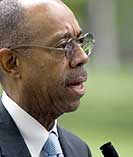
UC-Irvine's new chancellor continues his long career at UC.
Long-time followers
of the Technology Source will be happy to hear that archived materials of the
retired eJournal have found a new home since
Michigan Virtual University’s
withdrawal of hosting services earlier this year. By mid-summer, search functions
and “read-related” features will be available via
University of North
Carolina’s ibiblio server at
www.technologysource.org,
says Jim Morrison, the journal’s founder.
NEW CHANCELLOR. Michael
V. Drake, MD has been appointed chancellor of
University of California-Irvine.
The fifth chancellor of that campus, Drake assumes the role this month, continuing
a long career at UC, most recently as UC’s vice president for Health Affairs.