Making a Connection: Wirelss and VoIP Campus Trends
DATA FROM Campus Computing 2004, Casey Green’s 15th national
survey of computing and IT in higher education, depict continuing gains in the
deployment of wireless networks (Wi-Fi) on campuses. The annual report for 2004
summarizes data collected from 516 two- and four-year public and private colleges
and universities across the US:
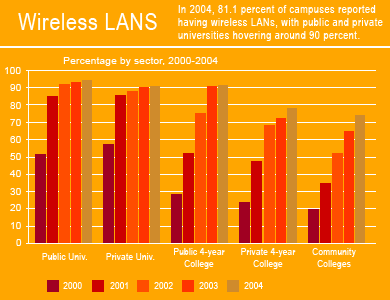
- More than four-fifths (81.1 percent) of the campuses surveyed reported wireless
LANs.
- A fifth (19.8 percent) of campus respondents reported that they have full-campus
coverage.
- Nearly one-third (31.0 percent) of higher ed classrooms now have wireless
connectivity.
- On average, across all institutions, wireless networks now cover more than
one-third (35.5 percent) of the campus service area.
Wireless has made huge leaps since 2000, when just 29.6 percent of campuses
surveyed reported wireless LANs and only 3.8 percent had full-campus coverage.
What’s next? Even more growth, most likely. Institutions ranked wireless among
their “Top 5 Issues” in the 2004 survey, and 55.3 percent reported that they
had strategic plans for wireless networking. The 18.9 percent gap of institutions
not possessing wireless LANs may narrow, especially in the private four-year
and community colleges, where, though the gap is larger, 10 percent and 15.1
percent of institutions, respectively, are scheduled to initiate wireless services
in academic year (A/Y) 2005-2006. But a more dramatic bump may occur in institutions
deploying full-campus wireless access: More than a third (35.7 percent) of all
institutions surveyed expect to begin to provide full-campus coverage in A/Y
2005-2006; added to existing full-campus deployments, this opens up the possibility
for more than half of institutions to have ubiquitous coverage by 2006.
The question of whether campus IT will meet expectations for wireless services
is still open, but where wireless is in short supply, demand is clear. Says
Green: “Students and faculty come to campus wondering about the absence of wireless
services in dorms, offices, classrooms, and the campus quad, when they may already
have wireless at home.” Inexpensive wireless components are widely available
to consumers, and increasingly, students will arrive on campus habituated to
wireless mobile computing. “The survey data suggest that many campuses are playing
catch-up against the growing consumer proliferation of wireless,” Green adds.
Picking Up the Signal: VoIP on Campus
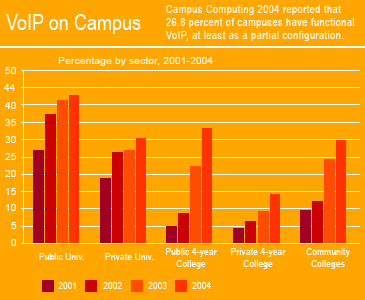
Campus Computing 2004 has also tracked VoIP deployment since 2001, and reports
that 26.8 percent of surveyed institutions have VoIP installations in place (publics
report 43.1 percent). With easy access to cellular service and cell phones ubiquitous
among student populations, there may be less pressure, at least from students,
to advance campus-provided telephony than there is to expand wireless access. Still,
20.5 percent of surveyed schools indicated that they would introduce VoIP service
in A/Y 2005-2006.