The NSF May be Measuring Your Institution’s Computing Power
Almost exactly
two years ago I wrote about a forthcoming survey by the National Science Foundation
(NSF) which is a biannual event that historically measures research space on
college campuses. In 2003 the NSF added an entire section to measure networking
capacity and I anticipated that IT folks on campus would be surprised by the
request to provide data that had not previously been asked for.
I really don’t know how “surprised” anyone was, but to my surprise, a considerable
number of institutions did in fact find the time to collect and share their
data with NSF. Four-hundred and sixty-five institutions responded to the survey.
Of those, only a tiny handful did not also provide network data. I’ll summarize
here a little bit of the early findings.
You may not know that precision measurement of the ‘Net Assignable Square Feet’
(NASF) of space devoted to research is a key part of the formula by which universities
pull out the “administrative overhead” dollars from the research grants received
by their faculty. Institutions are naturally very sensitive about this data
and the NSF was quite concerned that in 2003 there would be less participation
because for the first time ever, it is publishing the actual raw data publicly.
There was a slight decline in participation when compared to previous biannual
surveys, but not much, so the dataset is large enough to be useful.
With respect to the networking data, here is a sample table that was produced
for the initial web report, titled Universities
Continue to Expand Their Research Space with the Largest Increase Since 1988;
Data Reported for Networking Capacity. Note that for space data, institutions
were only asked about their research space but for network data the questions
were intended to elicit data for all networking and information technology,
whether used for research or not.
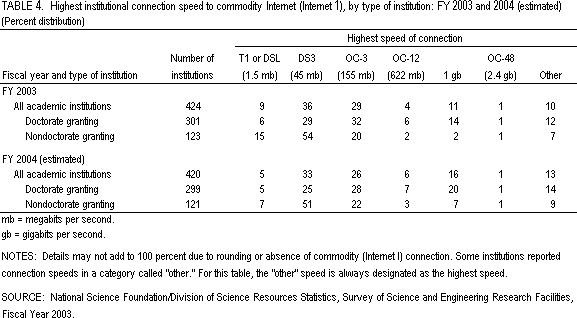
As with all of the tables in the initial report, an Excel file of the source
data for the table is also published here.
Further, individual institution data will be available from the Integrated
Science and Engineering Resources Data System, and a large set of additional,
detailed statistical tables with supporting data will eventually be available
on the NSF website.
So, what can we learn from the initial reporting?
- Well, doctorate granting institutions have more, higher-speed networks than
do non-doctorate institutions.
- Both kinds of institutions planed to increase the percentage of higher-speed
networks in the next fiscal year, even though perhaps not planning to increase
the number of connections on campus.
- More doctorate granting institutions are connected to Abilene (79 percent)
than of non-doctorate institutions (28 percent).
- Although wired connections are far more used for research than wireless,
everyone is moving to more and more wireless.
- An amazing 92 percent of reporting institutions claim to either have a centralized,
institution-wide IT plan or a college/departmental IT plan. But those plans
varied in terms of their coverage of networking versus computer workstations,
and so forth.
Like I said, this is a very initial report. A plethora of tables and analysis
is about to pour forth and I guess the point of my writing about this, this
week, is that if you care about this data and its analysis, you’ll want to be
keeping an eye on the websites I’ve linked to above.
SCUP member Leslie Christovich, who is the manager of this NSF project, has
said that folks who are really interested but who don’t want to wait for formal
publication of the data may contact her direct and she may then be able to make
it available on an individual basis: [email protected].