Campus Computing Research: Security Is Never Simple
Annual Campus Computing survey cites new exposures.
THE CAMPUS COMPUTING Project released its 2006 National Survey of
Information Technology in US Higher Education this past
October. Among the many areas studied, the comprehensive
survey of 540 US institutions reports that wireless networks
now reach more than half (51.2 percent) of college
classrooms. Survey responses also indicate that support for
open source has inched up slightly over recent years. And
the report passes along the good news that security incidents
actually declined in the past year.
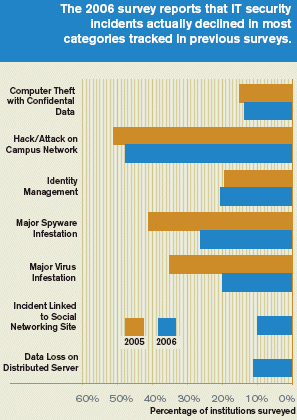
Yet the security picture isn’t so simple. The report flags
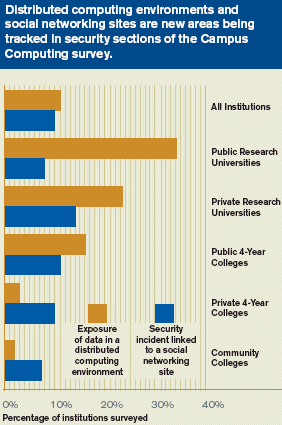
potential problems related to exposures of data on servers
not controlled by IT: “There’s a tension about distributed
computing and security protocols on many campuses,” says
Campus Computing founder Kenneth Green. “Research
labs, academic departments, and service units often want to
manage their own data and their own hardware. But the survey
data confirm recent news reports from individual colleges
and universities that servers not managed by central IT
services may be particularly vulnerable to hack attacks.” And
the new interest in social networking brings with it fresh
opportunities for incidents linked to sites such as Facebook or MySpace.
Security incidents involving such sites ranged from 7.5 percent
of responding community colleges to 13.7 percent of
private research universities, the survey reports.
Begun in 1990, the Campus Computing Project is widely
recognized as maintaining the largest continuing study of
computing and information technology in US higher education.
Executive summaries are posted as free downloads each year, and the longer
report may be ordered for a modest fee.