Emerging Tech Challenges

What keeps higher ed technology leaders up at night?

At Campus Technology's 2008 Executive Summit held in Boston this past summer (sponsored by CDW-G), moderator John Camp used audience polling from Turning Technologies to survey 50 IT leaders from diverse institutions and gauge the impact of emerging technologies on their campuses and on their evolving roles.

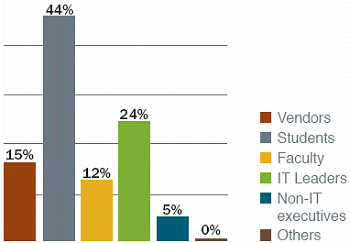
Who's Pushing New Technologies?. Response to the question "Who do you think is primarily pushing new technologies in higher education?" revealed students as the drivers (44%), but additional polling showed that IT leaders focus on wider institutional priorities even as they react to student expectation and demand.
Trendspotter

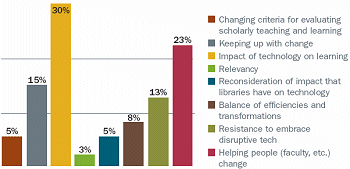
Challenges What are the challenges surrounding the deployment of emerging technologies? Participants suggested their own categories, and as a group ranked the following, among other criteria (right): • Impact of technology on learning (30%) • Helping people (faculty, etc.) change (23%) • Keeping up with change (15%) • Changing criteria for evaluating scholarly teaching and learning (5%)
Trendspotter

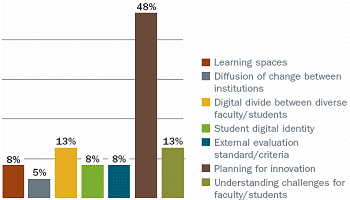
Additional Challenges In a ranking of "additional" challenges, participants singled out planning for innovation (48%) as the most significant challenge.

BOTTOM LINE: What were participants' "top challenges" overall? The following were worth heading into afternoon workgroup sessions for, according to the polls:

  • Driving IT toward institutional goals
  • Mass customization of learning
  • Planning for innovation
  • Impact of technology on learning

Trendspotter

Featured

  • Abstract neural network 3D illustration

    Intel® AI EmpowerED: The AI-Ready Campus, Delivered

    Artificial intelligence is transforming higher education, prompting institutions to rethink how they manage infrastructure, security, governance, and workforce readiness. Successful adoption requires a strategic, institution-wide approach that aligns AI initiatives with educational goals, faculty enablement, and scalable operational frameworks.

  • Minimalist binary data fragmentation

    Fragmented Data Is Quietly Undermining Student Success and Cybersecurity Hygiene

    Siloed tools, teams, budgets, and resources spread across departments and campuses generate massive amounts of data. However, fragmentation creates unnecessary exposure to security threats and inadvertently reduces student support because no one can see the whole picture.

  • broken digital lock and glowing chain

    Cybersecurity Researchers: AI Has Crossed into the Live Attack Chain

    AI is moving beyond assisting cybercriminals and beginning to operate within live attacks, according to a new report from Check Point Research. The technology is making sophisticated capabilities faster and more accessible while creating new security risks for businesses deploying their own AI systems.

  • Abstract background with digital shield made of data particles glowing blue blocking against cyber attacks

    Report: AI Attacks Push Organizations Toward Autonomous Cybersecurity Defense

    Artificial intelligence is raising the stakes of cyber conflict as attackers use the technology to accelerate reconnaissance, uncover vulnerabilities, and launch attacks faster than many security teams can respond.