MIT Tells Robo-Fish Story
- By Dian Schaffhauser
- 08/25/09
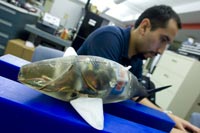
Mechanical engineer Pablo Valdivia with a robot fish. Photo: Patrick Gillooly/MIT |
A team of MIT researchers has built a new generation of robo-fish that emulate the swimming motion of the real creatures with the intent of sending them into underwater locations where traditional submersibles can't go. Fleets of the robots could be used to inspect submerged structures such as boats and oil and gas pipes; patrol ports, lakes and rivers; and detect environmental pollutants.
"Given the [robotic] fish's robustness, it would be ideal as a long-term sensing and exploration unit," said Pablo Valdivia Y Alvarado, a recent MIT PhD recipient in mechanical engineering and member of the team."Several of these could be deployed, and even if only a small percentage make it back, there wouldn't be a terrible capital loss due to their low cost."
Robotic fish have been around since 1994, when MIT engineers demonstrated Robotuna, a four-foot-long robotic fish. That early version had 2,843 parts controlled by six motors. The newest generation of robotic fish, which are less than a foot long, are powered by a single motor and are made of fewer than 10 components. Those are contained within a flexible, compliant polymer body that protects them from their wet environment. The motor, which resides in the "fish's" midsection, initiates a wave that travels along the fish's flexible body, mimicking biological locomotion and propelling the robot forward.
The team's first prototypes, which are about five inches long, mimic the swimming technique used by bass and trout. Most of the movement takes place in the tail end of the body. Later versions of the robo-fish, about eight inches long, swim like tuna, which are adapted for higher swimming speeds and long distances. In tuna, motion is concentrated in the tail and tail region, where the amplitude of body motions is greater. So far, the researchers have gotten their prototypes to move at speeds close to one body length per second, about a tenth as fast as the real creatures.
The MIT News Office has posted a video on YouTube that shows the motion of the fish in tap water--as well as the wires connected to an external power source. Each fish needs about 2.5 to 5 watts of power, depending on its size. In the future the researchers hope to power the robots with a small internal battery.
Later this fall, researchers expect to expand their research to more complex locomotion and test prototype robotic salamanders and manta rays. "The fish were a proof of concept application, but we are hoping to apply this idea to other forms of locomotion, so the methodology will be useful for mobile robotics research--land, air and underwater--as well," said Valdivia Y Alvarado.
Valdivia Y Alvarado provides a detailed model of the robot in his thesis, which will soon be published. The work was funded by the Singapore-MIT Alliance and Schlumberger, a global IT firm.
About the Author
Dian Schaffhauser is a former senior contributing editor for 1105 Media's education publications THE Journal, Campus Technology and Spaces4Learning.