New NEC Projectors Display Video in Unusual Places
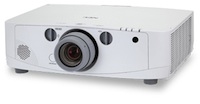
The 6,000-lumen NEC PA600X can project images on curved and angular surfaces. |
NEC has unveiled four high-brightness installation projectors with the ability to project images on nonwhite and three-dimensional surfaces, including cylindrical and spherical walls and the corners of rooms.
The new LCD projectors, the PA600X, the PA500X , the PA500U, and the PA550W, offer geometric correction for convex vertical cylinders, concave vertical cylinders, concave horizontal cylinders, and wall corners, as well as color correction for images projected on surfaces painted in black, gray, light rose, light green, light blue, light yellow, sky blue, and pink.
In addition to their ability to project corrected images on a variety of surfaces, the projectors also offer stacking correction, a feature that allows up to four projectors to create an overlapping image with a maximum combined brightness of 24,000 lumens. The projectors can be stacked both horizontally and vertically.
The PA500X and the PA600X offer native resolutions of 1,024 x 768 (XGA), while the PA550W ships with a native resolution of 1,280 x 800 (WXGA), and the PA500U offers a native resolution of 1,920 x 1,200 (WUXGA). The PA600X features the highest brightness of the four projectors, 6,000 lumens, while the PA550W is the next in line with a brightness of 5,500 lumens. Both the PA500X and PA500U offer a brightness of 5,000 lumens. All of the projectors offer a contrast ratio of 2,000:1.
Other features include:
- HDMI compatibility;
- RS-232 control;
- RJ-45 connectivity for networking with remote diagnostics capabilities;
- 1.33x zoom with manual focus;
- 10 watt mono speaker;
- Auto power on and sleep timer;
- Security features that include cabinet control lock and password protection; and
- ±40 degree horizontal keystone correction (±35 degrees on the PA500U) and ±30 degree vertical keystone correction.
The projectors feature edge blending, a technology used to combine multiple images from multiple projectors, and a DICOM simulation mode that reproduces grayscale images for medical training.
AV ports include two 15-pin RGB inputs, a 5-BNC input, an RGB display port, HDMI, RCA, S-video, and stereo audio out.
The PA500X, the PA600X, the PA550W, and the PA500U will be available this month for $3,199, $3,999, $3,399, and $5,499, respectively. All projectors include a three-year parts and labor warranty and a one-year, 500-hour lamp warranty.
Further information is available here.
About the Author
Dan Thompson is a freelance writer based in Brea, CA. He can be reached here.