Xirrus Intros Modular Wireless Switch Family
- By Dian Schaffhauser
- 10/11/11
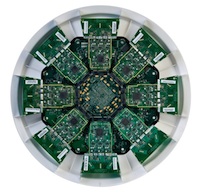
The new Xirrus XR series of wireless arrays offer upgradable hardware and software components. |
Wireless network vendor Xirrus has launched what it's promoting as the "first modular chassis-based wireless switch." The new XR series of wireless arrays allows IT staff to perform both radio and software upgrades, giving the devices a potentially longer life in the enterprise. The company added that these wireless switches will be able to accommodate upgrades to still-unfinished WiFi standards 802.11ac and 802.11ad. Along with the new switch product family, Xirrus has also released version 6.0 of XMS, its Xirrus Management System.
"With the explosive growth in mobile devices entering the enterprise, IT teams need to get serious about deploying a wireless infrastructure that can deal with the volumes of devices and data traffic that are overwhelming networks today," said Dirk Gates, founder and CEO of Xirrus. "Legacy wireless architectures cannot accommodate the expectations customers have for fast, scalable, and trusted wireless connectivity. It's time for a radical rethinking of how to support the wireless enterprise--both to meet surging demand now, and to assure enterprises that it's no longer a rip-and-replace scenario, but a scale-and-upgrade scenario, that can guide their wireless growth and expansion strategies."
Two chassis models of the Xirrus XR array are available, each with different access point configurations and each promising multi-gigabit bandwidth capacity. The XR-4000 series, intended for more enclosed environments and medium device density, can have four or eight 802.11n access points; it supports 300 Mbps or 450 Mbps data connectivity with up to 768 devices. The XR-4000 set is available now.
The XR-6000 series, expected in December, is intended for high device density in open spaces. It can have eight, 12, or 16 access points, also with 300 Mbps or 450 Mbps performance and supporting up to 1,536 devices.
Both sets of configurations include high-gain directional antennas and dedicated chips for firewall and threat sensor operations. The same array can support additional remote radios.
At the same time, Xirrus has upgraded XMS, which provides a central point of management for wireless network configuration and policy management, performance monitoring and reporting, security monitoring, troubleshooting, and ongoing maintenance.
Besides a new user interface, new features in version 6.0 of XMS include:
- Device identification, which enables policy enforcements, analytics, and reporting based on device types;
- Remote packet-capture for spectrum and performance analysis with a dedicated radio sniffer;
- Improved intrusion detection and intrusion prevention with a greater number of signatures and stronger threat management; and
- Legacy access point management for compatibility during network refreshes.
The new management system is available as a software-based virtual machine or hardware appliance.
About the Author
Dian Schaffhauser is a former senior contributing editor for 1105 Media's education publications THE Journal, Campus Technology and Spaces4Learning.