U Wisconsin-Milwaukee Rolls Out Mobile App Built on Open Source Platform
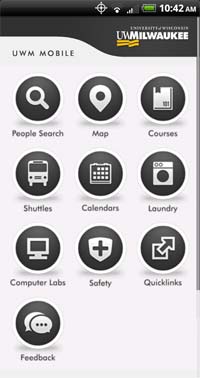
The University of Wisconsin-Milwaukee mobile app on Android |
The University of Wisconsin-Milwaukee has seen more than 9,000 downloads of an app developed in-house that provides students with easy access to campus information.
The university team began development of the app in January; it was beta tested in July and ready for use in early September.
The app, which was available to students at the launch of the fall semester in September, was developed for both iPhone and Android devices. It lets students with these mobile devices:
- View real-time course schedules and bus schedules;
- Check if washing machines and dryers are available for use;
- See a university calendar of events;
- Locate classes with GPS maps;
- E-mail or call professors; and
- Register for courses.
In addition, the application allows students to find out if there are terminals open at computer labs in real time and search for people and services at the university through its search function. It also provides safety information.
The university used free, open-source app development platform Appcelerator Titanium to build the two apps using JavaScript, which reportedly saved the school 80 percent in the cost of development. The cost to build the apps was $25,000, and the development staff had to generate only 3 percent of new code for the Android app.
Appcelerator Titanium is a free, open-source application development platform. It allows people who have Javascript, HTML, CSS, Python, Ruby, or PHP Web skills, to create, test, and publish mobile apps for iPhone, iPad, and Android. It includes more than 300 API options and has 100-plus customizable UI controls for native tables, buttons, alerts, dialogs, views, tabs, and buttons.
In addition, it features metrics tools; location-based services; access to share information via social media such as Facebook and Twitter; support for CSS3 and HTML5; and access to use camera/video camera and view photos or streaming video.
University of Wisconsin-Milwaukee is working on a second version of the apps to be released in several months. It is also planning to launch a course, in its School of Information Studies, focused on how to create mobile apps using the Titanium platform.
The University of Wisconsin-Milwaukee has approximately 30,000 students enrolled in graduate and undergraduate programs.
For more information, visit the University of Wisconsin Web site.
About the Author
Tim Sohn is a 10-year veteran of the news business, having served in capacities from reporter to editor-in-chief of a variety of publications including Web sites, daily and weekly newspapers, consumer and trade magazines, and wire services. He can be reached at [email protected] and followed on Twitter @editortim.