New U Iowa Library Commons Delivers Academic and Tech Support
The University of Iowa community will be enjoying a new study and instructional space that opens this week along with the start of classes. The new space, pegged as a "concierge type service," occupies half of the first floor in the Main Library and provides a 24-hour study space and academic help center. The $14.5 million initiative, which has been under development for a couple of years, is a joint project of Information Technology services, Libraries, and the Office of the Provost, which funded the work.
The 37,000 square feet of the Learning Commons, as it's being called, has 18 group study spaces with large screens, 100 desktop and laptop computers, and room for students to use their own computing devices. A 45-seat "smart" classroom has been built on the Transform/Interact/Learn/Engage (TILE) model with glass walls and sliding doors and ample tech gear, including printers and scanners, TVs and projectors, and other multimedia resources. When nobody is using the TILE room, the sliding doors can be opened so students can use the space. The Commons also includes high-speed wireless.
This isn't the only learning commons on campus, but it is the "flagship one," according to Kristi Bontrager, libraries publicist. The others are "much smaller," she said, and lack the accumulated "resources and services."
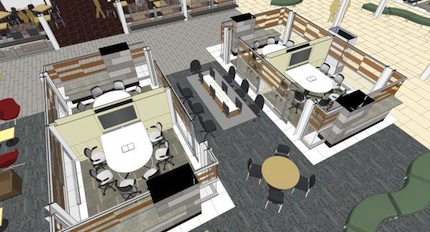
From U Iowa's Library Commons renderings gallery. The Learning Commons features glass walls and sliding doors and ample tech gear, including printers and scanners, TVs and projectors, and other multimedia resources. |
Likewise, the library already had a TILE classroom, which is used "all the time," Bontrager said. "And that's why we knew we needed another one."
To make sure students have a chance to try out the new space, the university hosted an open house for 4,500 new arrivals on campus featuring "tech geniuses to show students how to use the technology that's new," noted Bontrager.
In the center of the Commons will be a "consolidated" service desk, where technical and library workers will be able to tackle academic and IT-related questions, check out books, and direct students to other services as needed.
Also, patrons won't have to leave to get food. A "The Food for Thought" café, which already existed, has been expanded to accommodate sit-down business with made-to-order sandwiches, smoothies, and other snacks, along with gourmet coffees.
Because students had requested a 24-hour study space on campus, the Commons will provide that with the exception of Friday and Saturday nights. Previously, the library was only open 24 hours a week before final exams. While the Commons can remain open in the wee hours, the site has been designed to accommodate closing the rest of the library.
A new library staff member has been assigned that graveyard shift; but the site will also be staffed by library and graduate students who have been cross-trained "to offer research help as well as IT help."